He Pitches On Saturday And Catches On Sunday — And Nobody's Counting What That Costs The Arm
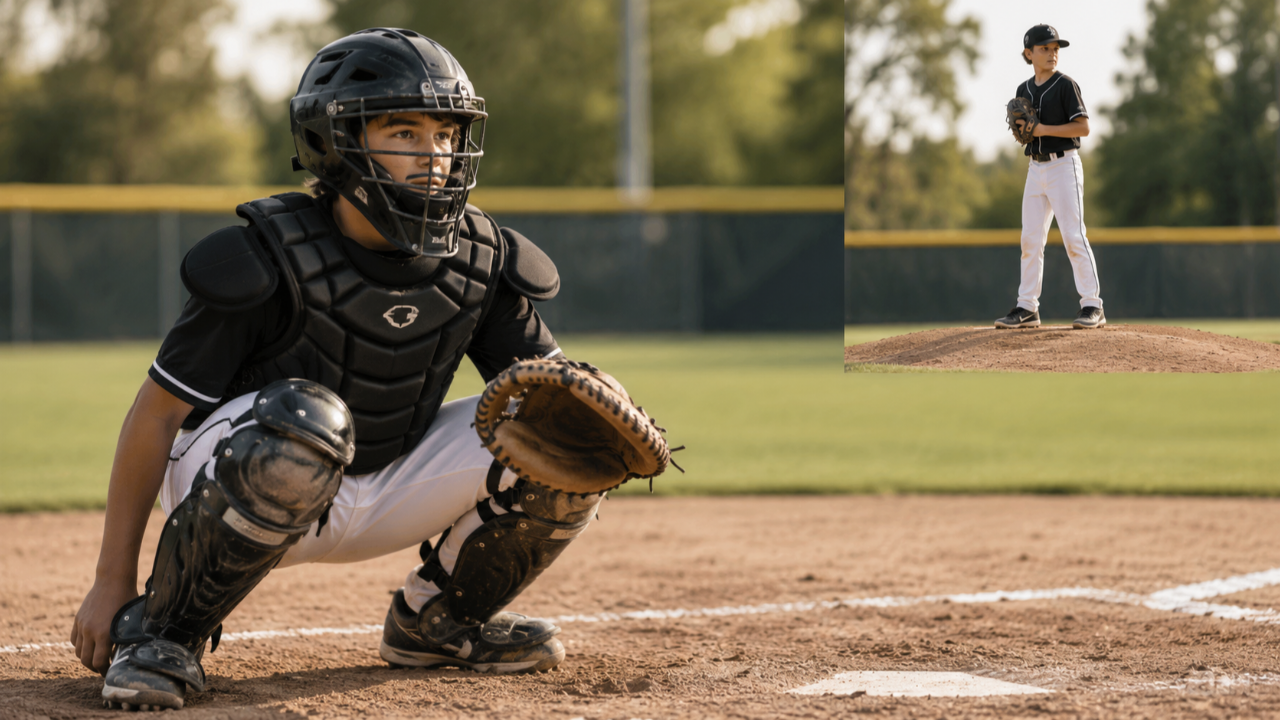
He's a pitcher on the travel team and a catcher at his school. Or he catches for one coach and takes the mound for another. You've heard the conversations — "We need him behind the plate this weekend" and "He's scheduled to start Friday." And you're trying to figure out how much of this is too much, because nobody is adding it all up.
The problem isn't either role on its own. Plenty of pitchers catch. Plenty of catchers pitch. The problem is that the two roles together create a type of arm load that pitch counts, innings limits, and every standard rest guideline in travel baseball is completely blind to. One team tracks the pitching. The other team tracks the catching. Nobody tracks both.
This post is about what that combined load actually looks like — the throws that don't get counted, the recovery math that doesn't work, and the signals that tell you the arm is approaching its limit before it announces itself with something sharp.
Why Does Playing Catcher Add So Much Arm Stress for a Youth Pitcher?
Every throw a catcher makes — pop times to second base, between-inning warm-ups, throwbacks after wild pitches — is near-maximum effort, and none of it shows up in any pitch count app.
Consider what a catcher actually throws in a game. A pop time to second base covers approximately 127 feet at close to maximum effort — typically delivered from a different arm angle than pitching, with a faster arm action and less of the lower-half contribution that distributes force across the body during a mound delivery. That difference in mechanics isn't just a technique question. It's a different stress pattern on the same arm structures.
In a typical youth baseball game, a catcher might make 15 to 25 or more high-effort throws: several pop times across the game, 4 to 5 warm-up throws to the bases between each half-inning, and additional throws from unexpected situations — rundowns, passed balls, pitch-outs. That's a meaningful throwing session by any measure. It just doesn't have a name. It doesn't get counted. And when the same kid also pitches, neither coach has the full picture of what that arm absorbed over the weekend.
This is the gap pitch counts don't measure applied to the dual-role player specifically. A pitcher-catcher's actual weekly throwing load can be two to three times what either team's pitch count reflects.
What the Saturday-Pitch, Sunday-Catch Weekend Actually Costs
A pitcher who takes the mound Saturday and squats behind the plate Sunday is asking the arm to absorb a second round of high-demand throwing before the first round has cleared — and the arm doesn't know it's a different role.
Research published through the American Sports Medicine Institute and related youth pitcher workload literature consistently shows that full neuromuscular recovery after a significant pitching outing takes 4 to 6 days. That's for a single role with no additional high-demand throwing during the recovery window. A pitcher-catcher's travel ball weekend typically doesn't offer that window. Pitch Saturday, catch Sunday, maybe a bullpen Tuesday, school workout Thursday — the arm is sprinting when it needs to be walking.
The catching game on Sunday isn't starting from a recovered arm. It's starting from an arm that's already carrying Saturday's fatigue. Each pop time at 24 hours post-pitching is a harder ask than the same throw would be on a rested arm. The arm doesn't fail at that moment — it accumulates. And accumulation is quiet until it isn't.
"He was sore Sunday, fine Monday, sore again by Wednesday" is one of the most common patterns parents of pitcher-catchers describe. That cycle — partial recovery, new demand, partial recovery, new demand — is how arms reach their limit without a single dramatic event. For more on how that summer arm overload pattern builds across a travel ball season, that post covers the broader context.
What Dual-Role Youth Pitcher-Catcher Arm Overuse Actually Looks Like
Dual-role overuse tends to build gradually — stiffness that doesn't fully resolve between game days, soreness that moves from elbow one week to posterior shoulder the next, and a slow velocity decline with no obvious single cause.
The migrating soreness pattern is worth naming specifically, because it's common in pitcher-catchers and easily misread. The catching role tends to stress the posterior shoulder — the back of the throwing arm's shoulder — through repeated receiving, blocking, and the deceleration demands of catching high-velocity pitches. The pitching role tends to stress the medial elbow (inside of the elbow) — where UCL stress accumulates in pitchers carrying high bilateral throwing load — and the anterior shoulder. In pitcher-catchers, these early UCL warning patterns can develop alongside catching-specific posterior shoulder signals simultaneously, which is part of why the full picture is so easy to misread as "just feeling off." When both patterns are present at the same time, parents often describe it as "his arm just feels off, but not in one specific place."
That diffuse, moving soreness is not reassuring information — it's a signal that the arm is absorbing more total load than it's recovering from between sessions. It's different from the clean, resolving soreness of a single pitching outing. It's the accumulation pattern.
Other things that show up in the dual-role overuse picture: warm-ups that consistently take longer than usual. Soreness that's present before the first pitch on game day. Velocity that trends down across pitching outings even after rest days. Any of these patterns, week over week, is worth paying close attention to.
The Yellow Flags Pitcher-Catchers Show That Parents Miss
Pitcher-catchers often show a combination of posterior shoulder tightness and medial elbow awareness at the same time — and because those patterns come from different roles, they can mask each other in a way that makes the arm seem "manageable" when it's actually approaching a threshold.
A pitcher-catcher who is trending toward Yellow might look like this: his pitching velocity has been slightly down for two weeks, but it's only 2 mph so it seems minor. His shoulder feels tight in the morning after catching games, but it always loosens up within an hour so it seems fine. He's rubbing his elbow between pitching innings occasionally, but he says it's nothing. His warm-ups have been taking a little longer, but you attribute it to cold mornings.
None of those individual signals look alarming. Together, they're a Yellow week that's been accumulating unaddressed. The six arm signals that pitcher parents most commonly miss — the Elbow Rub, the Shoulder Shrug, the Stiff Turn, the "I'm Fine" Mask — are worth reviewing in the context of a pitcher-catcher specifically, because competitive kids playing two positions are especially motivated to mask what they're feeling.
Yellow for a pitcher-catcher doesn't mean stop everything. It means: reduce to one high-demand role this week, monitor the arm's recovery closely, and don't add a bullpen or extra session while the signals are present. Let the arm catch up before the demand continues. The same principle that applies after any arm setback applies here: clearance and readiness are different questions — and in a Yellow week, only one of them matters.
How Do You Track a Youth Pitcher-Catcher's Total Arm Load?
Track throwing events, not pitch counts — every pop time, every warm-up throw, every bullpen pitch represents arm stress, and the weekly total across both roles is what the arm is actually absorbing.
A "throwing event" is any high-effort throw regardless of context: a pitch from the mound, a pop time from behind the plate, a between-inning warm-up throw, a bullpen session pitch, a long toss rep. The arm doesn't assign less stress to a throw because it happened in the catching role rather than the pitching role. The tissue absorbs what it absorbs.
Practically, this doesn't need to be a spreadsheet. After each game or practice, make a rough estimate: "He threw about 65 pitches today, plus maybe 10 pop times and a few warm-up throws — call it 85 throwing events total." Do that across the week. A week where the total is 200+ throwing events with minimal recovery spacing between sessions is a week to reduce demand, not push through.
For context on what recovery between game days should actually look like — and how to read whether the arm has recovered before the next session — the recovery between games guide covers that structure directly.
Not sure if your pitcher-catcher's arm is in a Green, Yellow, or Red state heading into this weekend?
The 2-Minute Arm State Check asks 8 questions about your pitcher's arm right now — and gives you a clear read on what the arm can handle this week, whether the weekend involves one role or two.
Take the Free Arm State Check →What Does a Better Week Look Like for a Youth Pitcher-Catcher?
A week that works for a pitcher-catcher includes intentional spacing between high-intent throwing days — and in weeks where that spacing is unavailable, one role takes priority and the other is reduced.
The ideal scenario: pitch Saturday, then no high-effort throwing until at least Thursday. That gives the arm 4 to 5 days of reduced load before another demanding session. In travel ball, that spacing is rarely available — but it's the target the week should aim toward, even if imperfectly.
When a compacted weekend requires both roles: prioritize the role with higher consequence for the team and the athlete. Pitching typically carries more individual arm stress per session than catching, so if one role needs to be reduced, reduce the catching intensity where possible — sit one inning, limit between-inning warm-up throws to two or three instead of five, communicate with the catching coach about what the arm is carrying.
What doesn't work: treating each role as independent from the other, assuming that because the pitch count is under the limit everything is fine, or deciding after Sunday's game that "he seemed okay" without tracking what the arm actually did across both days. The arm is one arm. The week is one week. The load from both roles is the sum of all of it, not the higher of the two.
What Do Youth Baseball Rules Say About Playing Pitcher and Catcher?
Most governing bodies restrict same-day pitching and catching above certain pitch thresholds — but they don't address consecutive-day dual-role load, which is where most pitcher-catcher arm stress actually accumulates.
Little League Baseball prohibits a pitcher who delivers 41 or more pitches in a game from catching for the remainder of that same day. A catcher who catches four or more innings in a game is not permitted to pitch on that same day at most levels of play. These rules exist to prevent the most extreme same-day overload scenarios — and they're worth knowing.
What they don't cover is the scenario that plays out most often: pitching Saturday, catching Sunday. Playing two different leagues where no single coach has visibility into both roles. A school season that overlaps with a travel season where combined throwing volume falls on no one's radar. The rules close one door. The real risk lives in the space the rules never tried to regulate.
That space belongs to the parent. Not to manage every throw — but to see the whole picture when no one else on either team is looking at both sides of it.
The two roles aren't incompatible. Kids play both positions well into high school without arm problems — when the full load is being seen and managed. What changes outcomes isn't the identity. It's whether the arm is being tracked as a whole or in two separate, unconnected pieces.
You don't need to make him choose. You need to make sure someone is counting all of it.
Frequently Asked Questions: Youth Pitcher-Catcher Arm Health
Is it safe for a youth player to both pitch and catch?
Playing both pitcher and catcher is not automatically unsafe, but it creates a type of arm load that no standard pitch count or innings limit tracks. The risk isn't either role on its own — it's the combination of high-effort throwing from both positions with inadequate recovery between them. A pitcher-catcher whose schedule puts both roles in the same weekend, or across consecutive days, is accumulating significantly more arm stress than any single-role pitcher with the same number of mound pitches. The key is tracking the total load, not just each role separately.
What do youth baseball rules say about playing pitcher and catcher?
Little League Baseball rules prohibit a player who delivers 41 or more pitches in a game from catching in that same game. Similarly, a player who catches four or more innings in a game is not permitted to pitch on that same day at most levels of play. These rules prevent the worst same-day dual-role scenarios. However, they do not address consecutive-day load — pitching Saturday and catching Sunday, or playing on two different teams where no one tracks the combined count. That gap is where most pitcher-catcher arm stress accumulates, and it's entirely on the parent to close it.
How much throwing does a catcher actually do in a game?
A catcher typically makes 15 to 25 or more high-effort throws in a youth baseball game — including pop times to second base (approximately 127 feet at near-maximum effort), between-inning warm-up throws to the bases, throwbacks on wild pitches and passed balls, and throws during rundowns. None of these throws are counted or regulated by pitch count apps. For a pitcher-catcher playing a game in each role across the same weekend, the catching game can add as much cumulative arm stress as a moderate pitching outing — with no tracking and no required rest days attached to it.
What are the signs that a pitcher-catcher is throwing too much?
Signs of dual-role overload include: shoulder or elbow soreness that doesn't resolve between game days, soreness that moves location from week to week (elbow one week, posterior shoulder the next), morning stiffness that takes longer to clear than it used to, a velocity drop across pitching outings that doesn't bounce back with rest days, and behavioral changes like adjusting arm path or warming up more cautiously without reporting pain. These patterns are especially worth tracking in players on multiple teams, where no single coach sees the full picture of what the arm is doing each week.
Should a youth player choose between pitching and catching to protect his arm?
Choosing one role permanently isn't always necessary — but in weeks when the arm is showing Yellow signals (soreness that lingers, stiffness that isn't clearing, any pattern of accumulation), reducing to one high-demand role that week is the right call. The goal isn't to eliminate the dual-role identity. It's to make sure the arm is tracked as a whole rather than in two separate, unconnected pieces. When recovery is adequate and the arm is clearly Green heading into each game, both roles can coexist. When it isn't, one role needs to give.
How do you track arm load for a player who pitches and catches?
Track throwing events, not just pitch counts. A throwing event is any high-effort throw regardless of context — mound pitches, pop times, bullpen sessions, between-inning warm-up throws. After each game or practice, note approximately how many high-effort throws happened in total across both roles. The weekly total across all throwing contexts — not any single game's pitch count — is what the arm is actually absorbing. When the weekly total is high and recovery signs are incomplete (soreness lingering past 48 hours, stiffness not clearing), the following week's dual-role demand should be reduced, not maintained.
Both roles this weekend. One arm. Here's a 2-minute read on what it can handle.
The Arm State Check gives you a Green, Yellow, or Red read on your pitcher's arm right now — accounting for what both roles have already asked of it this week.
Take the Free Arm State Check →