The Fear is Tommy John: The Answer is in Reading What His Arm Has Already Been Telling You
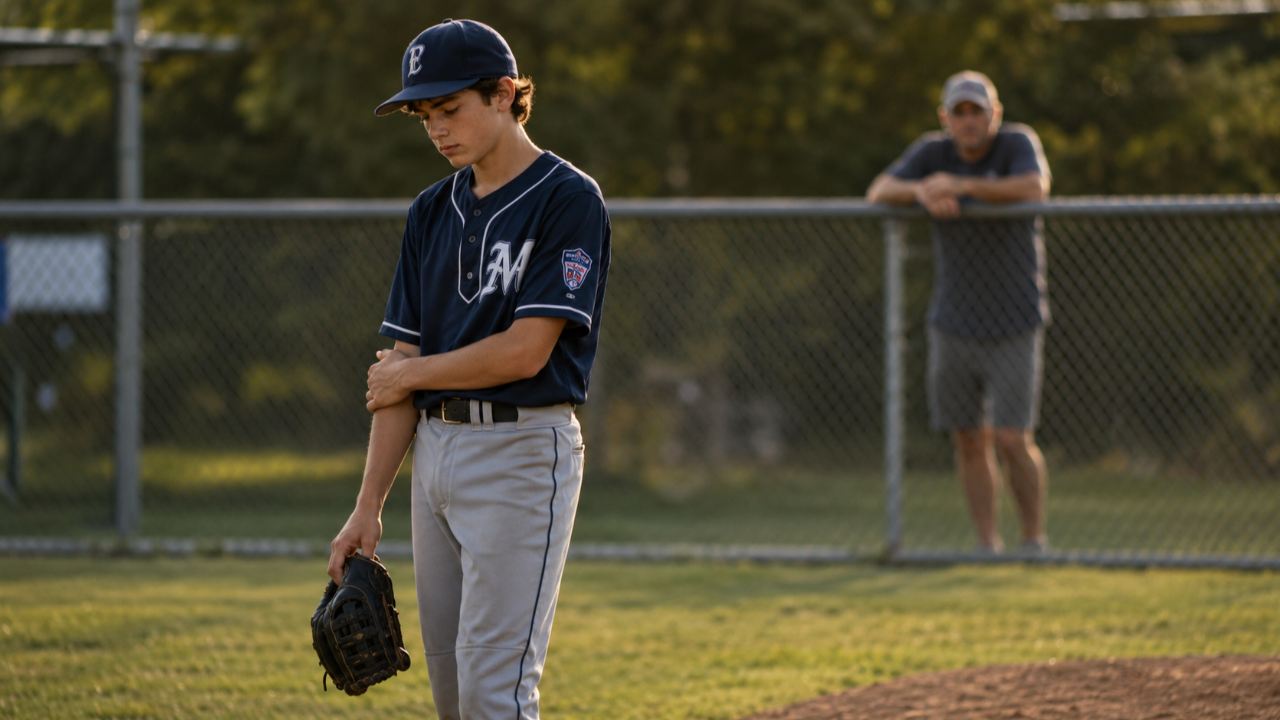
Somebody at the field mentioned it. Maybe it was a coach talking about another kid on the team. Maybe it was a parent. Maybe it was the moment your pitcher grabbed his inner elbow after a warmup pitch and you did a quick search and the first result that came up was Tommy John surgery.
Now you can't un-think it.
Tommy John surgery is real, it's rising in youth pitchers, and the fear of it is one of the most common things parents of young pitchers carry quietly — often for weeks before they say it out loud. This guide doesn't start with anatomy. It starts with what you actually need to know: how Tommy John surgery happens in youth pitchers, what the warning signals look like from the parent side of the fence, what the research says about prevention, and how to tell the difference between "we should get this looked at" and "we are headed toward a surgery conversation."
I'm Joey Myers. I built VeloRESET because I kept watching parents manage arm injuries with nothing but a clearance date and a calendar — and I knew week-to-week decisions deserved better information than that.
"The surgeon said the UCL had been under stress for a while — it wasn't one moment. And I kept thinking about all the times my son said his elbow felt 'a little off' and I just told him to push through it."
— Parent of a 15-year-old pitcher, travel ball
What is Tommy John surgery — and why are more youth pitchers having it?
Tommy John surgery reconstructs the ulnar collateral ligament (UCL) — the ligament on the inside of the throwing elbow that stabilizes the arm during the acceleration and release phase of every pitch. When that ligament is torn or has deteriorated to the point of structural failure, surgery replaces it with a tendon graft from elsewhere in the body. Recovery: 12 to 18 months, and in youth athletes sometimes longer.
The surgery is named after the first Major League pitcher to undergo it, in 1974. For decades it was understood as an adult injury — a consequence of years of professional throwing. That's no longer accurate.
ASMI research now estimates that roughly 25% of all Tommy John procedures are performed on athletes under 18. A 2016 study in the American Journal of Sports Medicine found a nearly tenfold increase in Tommy John surgeries among youth pitchers over the prior decade. The surgery isn't becoming more common because it's a better option — it's becoming more common because young pitchers are arriving at UCL failure earlier and more frequently than before.
The reasons aren't complicated: year-round pitching, multi-team participation, and the cultural pressure toward higher velocity at younger ages all create a cumulative throwing load the young elbow was never built to absorb across a 12-month calendar.
Is Little League elbow the same as needing Tommy John surgery?
No — and this distinction matters, because confusing the two leads to either over-panicking about a manageable injury or under-responding to one that needs attention.
Little League elbow is a growth-plate stress injury to the medial epicondyle — the bony bump on the inner elbow where the growth plate hasn't fully closed yet. In young pitchers, this cartilage structure is more vulnerable than the UCL ligament sitting adjacent to it. Little League elbow responds to rest without surgery in most cases and is primarily a condition of pitchers ages 8–14.
Tommy John surgery addresses UCL failure — a different structure entirely. The UCL is a ligament, not a growth plate. It can withstand more cumulative throwing load in total, but it can be pushed past its structural limit through years of repetitive stress — particularly when earlier growth-plate injuries were undertreated and a pitcher continued throwing through warning signals that should have triggered rest.
What connects them: both injuries affect the inside of the throwing elbow. Both produce medial elbow pain. Both are driven by repetitive throwing stress. And critically, a pattern of undertreated Little League elbow in a younger pitcher can change how the elbow develops — placing abnormal stress on the UCL as the growth plate closes and throwing intensity increases in high school.
A parent who recognizes Little League elbow signals at 11 or 12 and responds to them appropriately is doing the most practical Tommy John prevention available. The two injuries are connected by a timeline, not a diagnosis.
What are the early warning signs of UCL stress in a youth pitcher?
UCL stress rarely announces itself with a dramatic moment. The ligament doesn't usually fail on a single pitch — it accumulates damage over time. The signals appear weeks or months before the injury becomes structural.
The warning patterns parents can observe from the sideline:
- Inner-elbow tenderness present before throwing, not just after. Post-session soreness on the inside of the elbow is worth monitoring. Tenderness that's there before the arm is warmed up — present at rest or on touch — is the arm telling you something different than normal recovery.
- A velocity drop that persists across multiple outings. A single poor game isn't the signal. A sustained drop of 2–5 mph over three or four consecutive appearances, without an obvious mechanical explanation, is the arm communicating that something is being asked of it that it can't currently deliver.
- The Elbow Rub between pitches — the self-soothing gesture where a pitcher reaches across and touches the inner elbow without thinking. If it's becoming a habit, the inside of the elbow is accumulating stress. This is one of the six arm signals parents most consistently miss until they know what they're looking at.
- Pain that migrates. Some pitchers report that elbow discomfort shifts — sometimes it's the inner elbow, sometimes it shows up further along the arm or into the forearm or shoulder. Migrating pain can indicate the arm is compensating through altered mechanics, placing stress on secondary structures.
- Loss of command without a mechanical change. When a pitcher's command deteriorates noticeably — and it isn't a mechanics issue his coach has flagged — the arm is often unconsciously protecting itself by throwing with less conviction. The performance problem is a symptom. The arm is the source.
None of these require you to know what a UCL is or whether it's compromised. They require noticing a change across multiple outings — not reacting to a single game, but registering when a pattern is showing up that wasn't there before. For help separating normal post-game soreness from a signal worth acting on, see the guide on youth pitcher arm soreness vs. pain.
Seeing one or more of these patterns right now? The 2-Minute Arm State Check gives you a structured Green, Yellow, or Red read on what you're observing this week — and what to do about it.
Why is "he never said it hurts" not the all-clear it sounds like?
Youth pitchers underreport arm pain. This is one of the most consistent findings in youth sports medicine, and it makes complete sense when you think about what a pitcher has learned from the environment around him.
Saying "my arm hurts" results in sitting out, missing starts, worried parents, cautious coaches, and conversations no competitive kid wants to have. The incentive structure of travel ball teaches pitchers — through years of repetition — that the safe answer is "I'm fine." By the time that self-protective pattern is established, a pitcher often can't accurately report his own arm status even when he's genuinely trying.
The arm communicates instead through the behavioral patterns above. The Elbow Rub shows up. Warmup takes longer. Command disappears late in outings. Velocity trends down across the season. The arm tells you through performance and behavior what the pitcher isn't telling you through words.
This matters for Tommy John specifically because the standard parent logic — "if something were really wrong, he'd say something" — is not a reliable filter for UCL stress. The injury often develops through months of low-level signals the pitcher has adapted to and stopped registering. The parent who's watching the arm, not just waiting for the conversation to start, is in a fundamentally different position.
Noticing any of these patterns in your pitcher's arm right now?
The 2-Minute Arm State Check walks through 8 questions about what you're observing this week — and gives you a Green, Yellow, or Red read on where his arm stands. No medical knowledge required.
Take the Check →What actually increases a youth pitcher's Tommy John risk?
The three factors ASMI research identifies as most predictive of UCL injury — independent of per-game pitch counts — are pitching while fatigued, pitching on multiple teams simultaneously, and high total innings pitched per year. Pitch counts don't measure arm fatigue — they measure per-game pitching volume. Those are not the same thing, and the difference is where most UCL stress accumulates.
A pitcher who throws 65 pitches in a game, then takes 40 throws from shortstop at practice two days later, then pitches again 48 hours after that because he's on two rosters, has a real-world arm load that pitch count rules were never designed to capture. The UCL accumulates stress from all of it.
Additional risk factors the research supports:
- Pitching year-round without meaningful rest. Three to four months of arm rest per year is the ASMI recommendation. Most travel ball pitchers don't take it, and the arm never fully resets its baseline.
- Pitching with fatigue already present. The UCL is most vulnerable when the muscles surrounding the elbow — which normally absorb much of the throwing load — are exhausted and transfer their share to the ligament. The velocity drop, the longer warmup, the stiff-feeling outing: these are fatigue signals that precede ligament overload.
- High-intensity throwing before growth plates close. Maximum-effort pitching and velocity-focused training before skeletal maturity places more stress per throw on structures that aren't fully hardened. The arm can tolerate this in low doses. It can't tolerate it across an 11-month calendar at 80% effort or above.
- Undertreated earlier arm injuries. A pitcher who threw through Little League elbow at 12 and "got better on his own" may have developed compensatory mechanics that redistribute stress onto the UCL as throwing intensity increases in his mid-teens. The two injuries are connected across time, not just anatomy.
Does Tommy John surgery make pitchers throw harder?
No — and this myth has done real damage, because it creates a subtle rationalization that reduces the urgency of acting on early warning signals.
The narrative exists because some pitchers do show velocity improvement after Tommy John surgery compared to where they were before. But their pre-surgery baseline typically reflected significant UCL compromise — the arm was structurally failing, and velocity had already dropped. The post-surgery improvement is a return toward prior capability, not an upgrade beyond it.
What the research actually shows: roughly 57% of professional pitchers return to their prior performance level after Tommy John surgery. Approximately 25% do not return to competitive pitching at all. For youth pitchers — whose skeletal development is still active during the 12–18 month recovery — the data is less complete, but the timelines are typically longer and the risks of graft failure are real.
The surgery also doesn't end the arm-health management work. Post-surgery pitchers still need the same week-to-week workload monitoring, signal recognition, and clearance-vs-readiness thinking they needed before the injury. The UCL graft is replaced; the conditions that led to failure are not automatically corrected by the procedure.
The practical point for parents: Tommy John surgery is a reconstruction of a ligament that should never have been allowed to fail. Recovery is long, outcomes are uncertain, and the conversation parents should be having is not "if this happens, what's the recovery?" It's "how do we read the signals early enough that it doesn't have to?"
When should parents seek evaluation for inner-elbow pain in a youth pitcher?
Seek a sports medicine evaluation when inner-elbow pain is present during throwing — not just soreness the morning after, but discomfort that shows up at some point during the actual motion. That's the threshold. You don't need to wait for a dramatic pop or an obvious moment of injury.
The specific patterns that warrant an appointment rather than another week of watching:
- Inner-elbow tenderness present before the arm is warmed up
- Pain that shows up consistently during the throwing motion — at acceleration, release, or follow-through
- Elbow soreness that hasn't resolved after 72 or more hours of genuine rest
- Any session where the pitcher stops mid-pitch or significantly alters mechanics because of elbow discomfort
- A recurring "something feels off" pattern on the inner elbow across two or more consecutive outings
A sports medicine physician — ideally one who works with throwing athletes specifically — can examine the elbow, order imaging if appropriate, and assess whether what you're seeing is a structural concern or a workload management situation. That clarity is worth getting early, when options are still numerous.
A note on what follows: medical clearance after an elbow evaluation answers whether the arm is safe to begin throwing again. It doesn't answer how much throwing the arm can absorb, at what intensity, on what schedule. That's the Cleared ≠ Ready gap — and it's where many pitchers re-injure themselves after a rest period, not because they ignored the doctor, but because nobody was tracking the arm's actual response to the workload as it ramped back up.
What does Tommy John prevention actually look like week to week?
Prevention doesn't happen in the off-season. It happens in the decision made on a Tuesday in July when a pitcher has thrown three days in a row and the weekend tournament starts Friday.
The evidence supports three things that actually move the needle:
Workload awareness beyond pitch counts. Total arm load — game pitches, practice throws, bullpen sessions, warmup throws, position-player throws — all accumulates. The pitcher whose arm is already stressed doesn't get more recovery just because his pitch count was low in the game. The week is the unit, not the outing.
Fatigue recognition before it compounds. The velocity drop, the longer warmup, the Elbow Rub between pitches — these are the arm asking for space before load reaches a structural level. Responding to Yellow signals before they go Red is where prevention actually lives. Not a strengthening program. Not a pitch-count app. The decision made the week a Yellow signal appears to reduce demand rather than push through it.
Early evaluation culture. The parent who takes their pitcher to a sports medicine physician at the first sign of persistent inner-elbow pain — not a dramatic injury, just a recurring pattern — is doing prevention work. Most UCL stress that becomes surgery had readable warning signals at a point when rest and workload management could have changed the outcome. The parents who catch it there are the ones who make the appointment before they're absolutely certain something is wrong.
None of this requires a medical degree. It requires a way of noticing what the arm is already communicating, week to week, so that the decision to reduce demand or seek evaluation comes before the injury makes that decision for you.
Frequently asked questions about Tommy John surgery and youth pitchers
How common is Tommy John surgery in youth pitchers?
Tommy John surgery is now performed on youth pitchers at rates that would have been unrecognizable 20 years ago. ASMI estimates that approximately 25% of all Tommy John procedures are now performed on athletes under 18. A study in the American Journal of Sports Medicine found a nearly tenfold increase in youth Tommy John surgeries over a recent decade. The primary drivers are year-round pitching, multi-team participation, and cultural pressure toward high-velocity throwing before skeletal maturity.
Is Little League elbow the same as Tommy John surgery?
No — they are different injuries affecting different structures on the same inner-elbow region. Little League elbow affects the growth plate (medial epicondyle) and is most common in pitchers ages 8–14. Tommy John surgery repairs the UCL (ulnar collateral ligament), a ligament injury that more commonly affects older adolescent and adult pitchers. Both produce medial elbow pain and both are driven by repetitive throwing stress, but they require different responses. Undertreated Little League elbow can contribute to conditions that increase UCL stress as a pitcher matures and throwing intensity increases.
What are the earliest warning signs of UCL stress in a youth pitcher?
UCL stress typically accumulates without a single dramatic event. The earliest observable signs include: inner-elbow tenderness present before the arm is warmed up (not just the morning after a session), a sustained velocity drop across multiple outings without a mechanical explanation, habitual elbow-rubbing between pitches, loss of command that isn't connected to a mechanics change, and any recurring pattern of "something feels off" that the pitcher has adapted to and stopped reporting. Pain that appears during the throwing motion — not only after — is the clearest threshold for seeking evaluation.
Does Tommy John surgery make pitchers throw harder?
No. Some pitchers show velocity improvement after surgery compared to their compromised pre-surgery baseline, but that baseline typically reflected a failing UCL — the arm was already in structural decline. The post-surgery improvement is a return toward prior capability, not an upgrade beyond it. ASMI data suggests roughly 57% of professional pitchers return to their prior performance level. Approximately 25% do not return to competitive pitching at all. For youth pitchers, recovery timelines are typically longer and outcomes less predictable.
Can Tommy John surgery be prevented?
The evidence supports three approaches that reduce UCL injury risk: reducing total throwing load (not just per-game pitch counts), avoiding pitching when fatigued, and taking meaningful off-seasons from throwing. Early response to inner-elbow warning signals — seeking evaluation before the injury becomes structural — is also a practical form of prevention. Most UCL injuries that lead to surgery had observable warning signs at a stage when rest and workload adjustment could have changed the outcome.
How long is recovery from Tommy John surgery for a youth pitcher?
Recovery is typically 12 to 18 months before returning to competitive pitching. In youth pitchers, whose skeletal development is still active during recovery, timelines can extend further. Return to full game intensity — not just throwing — is the relevant milestone, and many pitchers experience a window of two years or more from surgery date to feeling fully restored. Tommy John surgery is not a short-term injury; it is a multi-year disruption to development and competition.
At what age can a youth pitcher have Tommy John surgery?
Tommy John surgery can be performed on adolescent pitchers, including those still in middle school, though surgeons and sports medicine physicians typically prefer to wait until growth plates have closed when possible. In cases where the UCL has failed structurally and rest is not resolving the situation, surgery may be necessary in younger athletes. The decision involves the treating surgeon, the family, and a careful assessment of whether non-surgical management has been genuinely exhausted first.
What should parents do if they suspect UCL stress in their pitcher?
Schedule an evaluation with a sports medicine physician who works with throwing athletes — don't wait for a dramatic event or a single definitive moment of pain. Persistent inner-elbow tenderness during throwing, a velocity pattern that isn't recovering, or a recurring "something feels off" across two or more consecutive outings are all reason enough to get clarity before the situation narrows your options. Early evaluation when the signal is still manageable is prevention. Waiting until the injury is structural is crisis management.
You know what signals to watch for. Now get a personalized read on where his arm actually stands this week.
The Arm State Read walks through your pitcher's specific situation — what the signals mean for his arm right now, and exactly what to do about them. Not a general guide. A read on his arm.
Get the Arm State Read →$27 · Personalized to his arm right now
VeloRESET provides educational information for parents of youth baseball pitchers. This content is not a substitute for evaluation, diagnosis, or treatment by a qualified medical professional. If your pitcher is experiencing elbow pain, consult a sports medicine physician.