His Elbow Is Sore on the Inside — Here's What Little League Elbow Actually Is
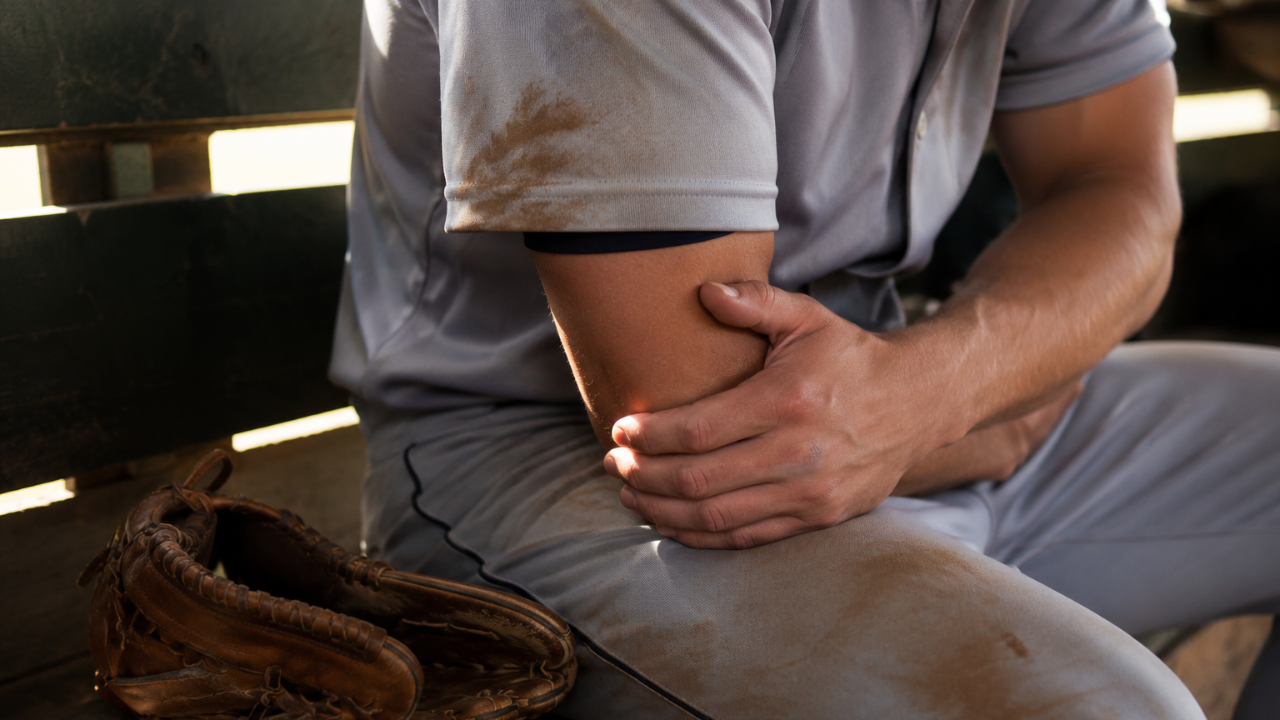
He mentioned his elbow after practice. Maybe it was vague — "it's kind of sore on the inside." Maybe it was more specific — "it hurts right here when I throw." Either way, you're now trying to figure out what you're actually looking at.
Little League elbow is one of the most common arm injuries in youth pitchers, and one of the most misunderstood. It's not a single dramatic moment — no pop, no collapse. It builds. And the window between "something's off" and "he needs to stop throwing" is often shorter than parents expect.
This guide explains what Little League elbow actually is, what the symptoms look like from a parent's vantage point, how it differs from Little League shoulder (a question parents often ask), what the research says about how young pitchers end up here — and what week-to-week readiness monitoring looks like once the arm is healing.
I'm Joey Myers. I built VeloRESET because I kept watching parents manage arm injuries with nothing but a clearance date and a calendar — and I knew week-to-week decisions deserved better information than that.
"The coach said he'd be fine if he toughened up. But every time I pressed on that bump on his elbow, it clearly hurt him. I didn't know what to do with that."
— Parent of a 12-year-old pitcher, travel ball
What is Little League elbow?
Little League elbow is a stress injury to the growth plate on the inside of the throwing elbow. The medical term is medial epicondyle apophysitis — which means inflammation at the bony bump on the inner elbow where the growth plate hasn't fully closed yet.
In children and adolescents, the growth plate is cartilage, not bone. That makes it softer — and significantly more vulnerable to repetitive stress than the surrounding muscle and ligament. Every throw places a tensile (pulling) force on the inside of the elbow. In adults, that stress is distributed across hardened bone and ligament. In a 10- or 12-year-old, it lands directly on cartilage that's still forming.
The result, when throwing volume exceeds what that tissue can absorb, is irritation, inflammation, and pain. Left unaddressed, it can progress to an avulsion fracture — where the bone fragment actually separates from the growth plate.
Most common age range: 8–14 years old. It typically peaks during the growth spurts that accelerate arm length but lag behind the tissue strength to match it. A pitcher can go from no symptoms to significant elbow pain over the course of a single travel ball season — particularly if he's pitching on multiple rosters or coming off a winter with little arm rest.
What does Little League elbow feel like? What your pitcher might tell you
The most consistent symptom is pain on the inside of the throwing elbow — the side closest to the body when the arm hangs naturally. It's often described as:
- "It hurts right here" (pointing to the medial bump on the inner elbow)
- Pain when throwing, especially at the point of release or acceleration
- Aching or stiffness after a game or bullpen — sometimes not until the next morning
- Tenderness when you press on that inner bump with a finger
- Reduced velocity or "something feels off" even when nothing obviously hurts
What you may not hear: a dramatic moment of injury. Little League elbow typically accumulates over weeks of repetitive stress. Many pitchers downplay it or don't notice it as pain until the inflammation has been building for some time. The "I'm Fine" mask — throwing through discomfort without reporting it — is one of the six arm signals parents most consistently miss.
Tenderness is the clearest physical marker parents can check at home. Have him straighten his arm and locate the bony bump on the inner side (it protrudes more than the outer side). Gentle pressure there that produces pain is a meaningful signal — not a diagnosis, but worth taking seriously. For help distinguishing what's normal post-throw soreness versus a real warning sign, see youth pitcher arm soreness vs. pain.
Noticing tenderness or several of these patterns right now? The 2-Minute Arm State Check gives you a structured read on what you're seeing — and what this week's throwing plan should look like.
Is Little League elbow the same as needing Tommy John surgery?
No — and this distinction matters, because the fear of Tommy John is often what makes parents minimize what they're seeing, hoping it goes away on its own.
Tommy John surgery repairs the UCL — the ulnar collateral ligament — on the inner elbow. The UCL is a ligament that stabilizes the elbow during the throwing motion. UCL injuries are primarily an adult and older adolescent problem, and they typically require surgery when the ligament tears.
Little League elbow is different. It's a growth plate stress injury — to bone tissue adjacent to the UCL, not the ligament itself. Most cases resolve with rest and reduced throwing load. Surgery is rarely required when the injury is caught before it progresses to avulsion fracture.
That said: untreated Little League elbow can become a more serious structural problem. The American Sports Medicine Institute (ASMI) has documented that youth pitchers who throw more than 100 innings in a single year are approximately 3.5 times more likely to require surgery at some point in their careers. The path from unmanaged elbow stress to structural damage is real — it just doesn't have to go that direction.
The most important difference: Tommy John requires surgery and 12–18 months of recovery. Little League elbow, addressed early, typically requires 4–6 weeks of rest from throwing. The urgency is to catch it early.
How is Little League elbow different from Little League shoulder?
Little League shoulder is a separate growth-plate injury — same general mechanism, different location. Where Little League elbow affects the medial epicondyle (inner elbow), Little League shoulder affects the proximal humeral epiphysis, the growth plate at the top of the upper arm bone where it meets the shoulder socket.
The key differences parents need to know:
- Location: Elbow injury → inner elbow tenderness. Shoulder injury → pain at the top of the upper arm, near the shoulder joint, often felt during arm rotation or follow-through.
- Age range: Little League elbow typically appears in pitchers 8–14. Little League shoulder more often shows up in the 11–16 range, coinciding with later growth spurts and higher throwing velocities.
- Mechanism: Little League elbow is primarily a tensile stress injury — the inside of the elbow gets pulled. Little League shoulder is primarily a rotational stress injury — the growth plate at the humeral head is stressed by the torque of throwing.
- Hypermobility factor: Pitchers with hypermobile joints — excessive shoulder range of motion — can mask early Little League shoulder symptoms because the shoulder doesn't stiffen the same way a normal joint would. The injury can progress further before it's obvious from the outside.
Both injuries require the same immediate response: stop throwing, get a sports medicine evaluation, and rest from all throwing activity while the growth plate heals. Both are more common during growth spurts and in pitchers playing on multiple teams simultaneously — including pitcher-catchers, who accumulate rotational shoulder stress from catching on top of pitching-related elbow stress. For a full breakdown of how the two injuries differ in terms of symptoms, location, and recovery, see the Little League shoulder parent guide.
If your pitcher is reporting shoulder pain rather than inner-elbow pain, the growth spurt and arm changes guide covers what's happening structurally when height and tissue strength develop at different rates — and why the shoulder is particularly vulnerable during those windows.
Can he keep pitching with Little League elbow?
No. This is the hardest part of the conversation, especially mid-season.
Throwing through active Little League elbow accelerates the injury. The growth plate doesn't get stronger by being stressed — it gets more inflamed. If a pitcher pitches in pain, each subsequent game or bullpen compounds the tissue damage. What would have been 4–6 weeks of rest becomes 8–12 weeks, and the risk of avulsion fracture rises significantly.
The decision should be made with a sports medicine physician or orthopedic specialist who can examine the elbow — and in many cases, order an X-ray or MRI to assess the growth plate directly. Parents can't reliably assess growth plate status from the outside. What they can do is act on the signals early enough that the clinical picture is manageable.
If your pitcher has pain on the inner elbow that's present during throwing — not just soreness the morning after — that's a clinical threshold worth taking to a doctor, not managing at home through another week of games.
How long does Little League elbow take to heal?
For a straightforward case caught early: 4–8 weeks of no throwing. That means no pitching, no catch, no infield practice that involves throwing. Hitting is generally okay if the elbow isn't involved in the swing — though some pitchers compensate in ways that load the arm during the swing, so this is worth watching individually.
After rest, a graduated return-to-throw program — starting with short-distance flat ground throws at reduced intensity — bridges back to full pitching workload over another 2–4 weeks. The total window from first rest day to full game activity is typically 6–12 weeks, depending on severity and how quickly healing progresses.
One important note: being "cleared to throw" after Little League elbow doesn't mean the arm is ready for a full throwing workload. Medical clearance answers whether the injury has healed enough to begin throwing. It doesn't answer how much throwing the arm can absorb in the first weeks back, whether accumulated fatigue has reset, or whether the athlete's movement patterns have shifted during the rest period.
The "cleared to throw" gap is where many pitchers re-injure themselves — not because they went back too soon on paper, but because nobody was tracking the arm's actual response to the workload as it ramped back up.
What does return-to-throwing actually look like after Little League elbow?
Return-to-throwing after Little League elbow is a progression, not a decision. The progression has three phases — and rushing any one of them is where re-injury happens.
Phase 1 — Complete rest (4–8 weeks): No throwing of any kind. This is non-negotiable. The growth plate needs complete absence of tensile stress to begin healing. Light fitness work (running, lower body, general conditioning) is fine. Anything that puts rotational or pulling load on the inner elbow is not.
Phase 2 — Graduated flat-ground program (2–4 weeks): After clearance, the pitcher begins short-distance (30–45 feet) easy catches — light effort, no breaking balls, no long toss, no bullpen. The goal is to re-introduce throwing stress gradually and watch for any return of symptoms. If the inner elbow tenderness returns during this phase, that's important information — it means Phase 1 wasn't long enough, and the clock resets.
Phase 3 — Return to full workload (2–4 weeks): Distance and intensity increase progressively. Bullpen work is reintroduced. The pitcher moves from flat ground back to the mound, starting with reduced pitch counts and no max-effort outings. Velocity typically returns naturally — trying to force it back is a risk factor for re-injury.
VeloRESET's Return-to-Throwing Ramp Calculator helps parents track where their pitcher is in the progression and flags when the ramp is moving too fast for the arm's recovery signal. The difference between a successful return and a setback is usually not the Phase 2 throwing — it's whether someone is actually watching the arm's response to it week over week.
For more on the distinction between clearance and actual arm readiness, see arm readiness vs. clearance — which explains why "the doctor said he's fine" and "the arm is ready to throw" are two different questions.
Why pitch counts don't prevent Little League elbow
Pitch count limits reduce pitching volume. They don't reduce total throwing load.
A pitcher who throws 60 pitches in a game and then takes 50 throws from shortstop at practice — and goes home and plays catch in the backyard — has a real-world arm workload that pitch count rules weren't designed to measure. The growth plate doesn't distinguish between pitching volume and total throwing volume. It accumulates stress from all of it.
ASMI research has identified three factors that are more predictive of elbow injury risk than pitch count alone: total innings pitched per year, pitching on multiple teams simultaneously, and pitching when fatigued. None of these are captured by a per-game pitch count limit. For a full breakdown, see why pitch counts don't measure arm fatigue in youth pitchers.
This doesn't mean pitch counts are useless — they provide a floor, a minimum standard that prevents the worst single-outing overuse scenarios. But parents who rely on pitch counts as the only arm-health signal are measuring one variable in a multi-variable system.
What pitcher's arms actually need is workload awareness that includes recovery time, activity across all throwing contexts (games, practice, bullpens, warm-up), and week-to-week signal tracking — not just per-game volume. That's the gap pitch counts leave open, and it's where most youth pitcher arm injuries develop.
How does a growth spurt change Little League elbow risk?
Growth spurts are the single biggest untracked risk factor in youth pitching arm health — and they're almost never discussed in pitch count conversations.
Here's why they matter: when a young pitcher grows rapidly in height, the bones lengthen faster than the surrounding tendons, ligaments, and muscles can adapt. The result is a temporary mismatch — a longer arm with the same or less relative tissue strength. During this window, the forces generated by throwing create more stress per throw than they did before the growth spurt, even at the same velocity and effort level.
For the inner elbow specifically, this matters because the growth plate at the medial epicondyle is already the softest link in the chain. Add a 3-inch height gain over four months, and that growth plate is absorbing more tensile load per throw just as it's already under structural development stress. This is why many youth pitchers develop Little League elbow seemingly "out of nowhere" — they didn't change their throwing program, but the arm underneath it changed significantly.
The signals worth watching during and after a growth spurt:
- Any new inner-elbow tenderness in a pitcher who hasn't had it before
- Velocity that drops after a height gain (common — the arm is recalibrating, but it also means greater stress per throw if intensity stays the same)
- Mechanics changes — especially elbow drop or altered arm path — that appear without coaching change. These are often the arm self-protecting from a position it now finds uncomfortable.
- Recovery that takes noticeably longer than it did six months ago at the same workload
The general recommendation during active growth spurts: reduce throwing intensity (not necessarily volume), watch recovery closely, and don't use pre-spurt workload baselines to judge how much the arm can handle now. The pitcher may look the same on the mound — or even better — while the arm is managing more stress per rep than it did before. See growth spurts and pitching arm changes for a full breakdown of what's happening structurally.
What parents can watch for, week to week
The goal isn't to replace your son's sports medicine team — it's to recognize signals early enough that you're making an appointment when the situation is still manageable, not when it's already progressed.
These are the patterns worth tracking week to week, not just game to game:
- Elbow tenderness present before throwing, not just after — post-throw soreness that clears in 24 hours is different from an elbow that's tender to touch before he's warmed up.
- A velocity drop of 2–5 mph that persists over multiple outings — not a single bad game, but a sustained change. The arm often telegraphs fatigue through velocity before it telegraphs pain.
- Warmup that takes significantly longer than usual — a stiff elbow that needs 30+ pitches to feel right is telling you something about recovery between sessions.
- The "I'm Fine" mask — a pitcher who deflects arm questions or consistently says "I just need to warm up" may be managing through discomfort he doesn't want to disclose.
- Changes in arm path or mechanics that appeared on their own — elbow drop, altered release point, or delivery changes without coaching input could be compensation.
- Recovery trending slower across the season — a pattern where it takes longer each time to feel ready to throw again is more meaningful than any single data point.
None of these require medical training to notice. They require paying attention to the same arm over multiple outings, and taking what you observe seriously enough to ask the question before the answer becomes obvious.
Not sure what you're seeing this week?
The 2-Minute Arm State Check walks you through 8 questions about your pitcher's arm right now — and tells you whether what you're seeing signals Green, Yellow, or Red. No medical knowledge required.
Take the Check →Frequently asked questions about Little League elbow
Can Little League elbow turn into a Tommy John injury if my son keeps throwing?
Little League elbow and Tommy John (UCL) injuries are different structures — Little League elbow affects the growth plate, Tommy John surgery repairs the ligament. But throwing through Little League elbow does increase the risk of serious structural damage. The immediate risk is avulsion fracture, where the growth plate fragment separates, which requires surgery and a much longer recovery than the original injury would have. The longer-term risk is that persistent growth plate stress disrupts how the elbow develops structurally. Resting early keeps the injury in the manageable category. Throwing through it is how it stops being manageable.
How do I know if my son has Little League elbow?
The most consistent signs are pain or tenderness on the inside of the throwing elbow, pain that occurs during throwing (not just soreness the morning after), and tenderness when you press on the bony bump on the inner elbow. A sports medicine physician can examine the elbow and order imaging to assess the growth plate. These signals are reason enough to schedule an evaluation rather than waiting.
Is Little League elbow serious?
Yes — though most cases resolve without surgery when caught early. The risk of throwing through it is that growth plate stress progresses to avulsion fracture. For most pitchers who rest early, recovery is 4–8 weeks. For those who throw through it, timelines extend to 3–6 months or longer. Act on symptoms before the injury escalates.
What is the difference between Little League elbow and Little League shoulder?
Both are growth plate stress injuries, but they affect different locations. Little League elbow affects the medial epicondyle (inner elbow), most common ages 8–14. Little League shoulder affects the proximal humeral epiphysis (upper arm bone), more common ages 11–16. Little League elbow produces inner-elbow pain during acceleration; Little League shoulder produces pain at the upper arm or shoulder during rotation or follow-through. Both require immediate rest and sports medicine evaluation.
Can pitch counts prevent Little League elbow?
Pitch counts reduce per-game pitching volume — one risk factor — but don't capture total throwing workload across games, practices, bullpens, and warm-ups. They also don't account for pitching while fatigued or playing on multiple teams simultaneously. ASMI research identifies pitching more than 100 innings per year and pitching fatigued as predictors of injury, independent of per-game pitch limits.
How does a growth spurt affect Little League elbow risk?
Growth spurts significantly increase the risk because bones lengthen faster than tendons, ligaments, and muscles can adapt. During a growth spurt, throwing forces create more stress per throw on an already-vulnerable growth plate — even at the same workload as before. Pitchers who grow rapidly often develop Little League elbow seemingly out of nowhere. Reducing throwing intensity and monitoring recovery more closely during active growth spurts is a prudent adjustment.
What should parents do when their youth pitcher has elbow pain?
Stop throwing immediately and schedule an evaluation with a sports medicine physician. Don't manage inner-elbow pain at home through another week of games. Early evaluation gives you options; late evaluation removes them. While waiting for the appointment, rest from all throwing — practice, bullpens, warm-up, and casual catch.
What does return-to-throwing look like after Little League elbow?
Return-to-throwing is a three-phase progression: complete rest (4–8 weeks), graduated flat-ground throwing at short distances with reduced intensity (2–4 weeks), and progressive return to full workload including bullpen and mound work (2–4 weeks). Total timeline: 6–12 weeks. Being cleared to throw is a starting point, not a finish line — the arm's response during Phase 2 determines whether the progression continues or resets.
Can my son keep catching or playing other positions while resting from pitching?
Catching is typically not permitted during rest for Little League elbow — the mechanics of returning the ball to the pitcher place similar tensile stress on the medial elbow as pitching does. Outfield and corner infield positions with significant throwing are also generally restricted. Positions with minimal throwing — DH, or first base on teams where the first baseman doesn't field many hard throws — may be possible, but confirm with your treating physician. Staying connected to the team in a limited role is often good for a young pitcher's motivation; the key is knowing exactly which throwing activities are and aren't permitted during the rest window.
You know what Little League elbow is — now get a personalized read on where his arm actually stands this week.
The Arm State Read walks through your pitcher's specific situation — what the signals mean for his arm right now, and exactly what to do about them. Not a general guide. A read on his arm.
Get the Arm State Read →$27 · Personalized to his arm right now
VeloRESET provides educational information for parents of youth baseball pitchers. This content is not a substitute for evaluation, diagnosis, or treatment by a qualified medical professional. If your pitcher is experiencing elbow pain, consult a sports medicine physician.