Your Pitcher Was Just Diagnosed With Little League Shoulder: Here's What That Actually Means This Week
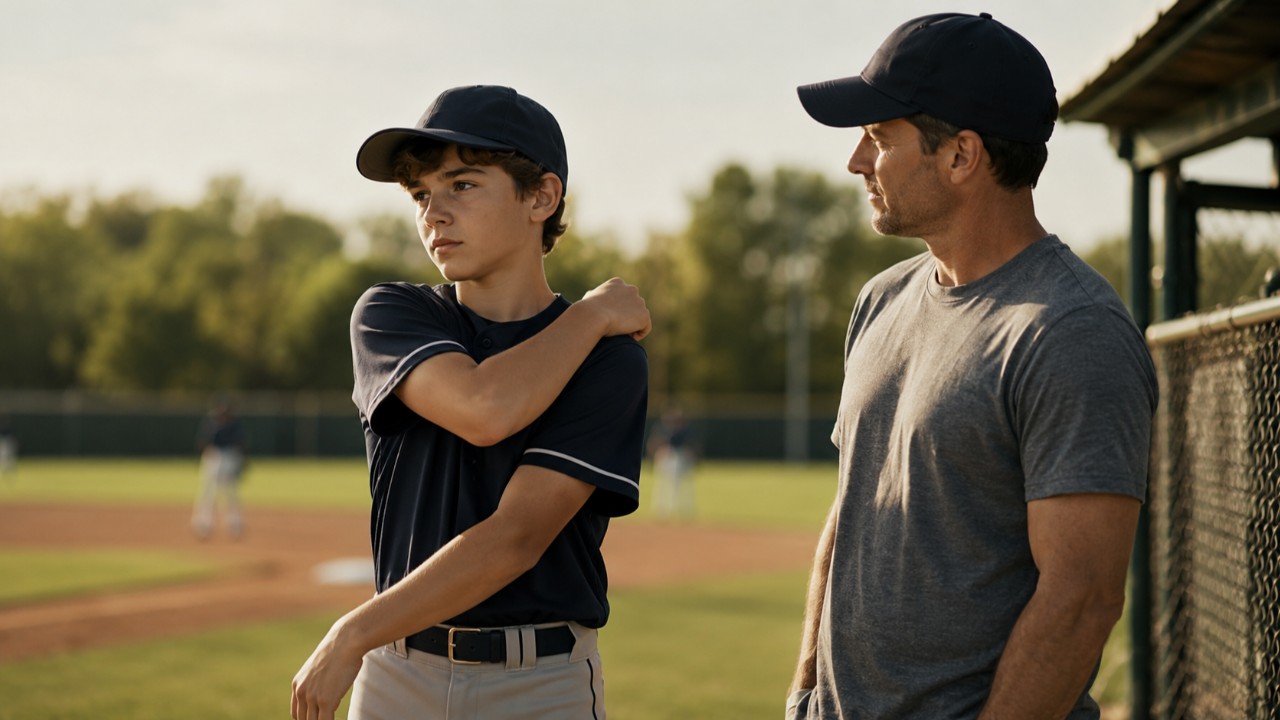
The orthopedist said "Little League shoulder." Maybe they also said three months off. And then the appointment ended. You're sitting in the parking lot with a diagnosis. You don't have a clear picture of what it means for the schedule. Not this week. Not next month. And not for whenever things are supposed to feel normal again.
But Little League shoulder is not a rotator cuff tear, not a dislocation, and not career-threatening when handled correctly. It does matter, though — the recovery window is not as simple as "rest it and he'll be fine." Still, the arm that comes back too soon often looks fine for a few weeks before the same pattern returns. The arm that comes back with the right information behind it tends to stay back.
This is a decision guide for parents managing the recovery window. Not a clinical explainer — you have a provider for that. This is about how to think about the weeks between diagnosis and the first bullpen back. What the injury actually is, what the timeline really means, and what signals tell you the arm is genuinely ready versus just rested.
I'm Joey Myers. I built VeloRESET because I kept watching parents manage arm injuries with nothing but a clearance date and a calendar — and I knew week-to-week decisions deserved better information than that.
"The doctor said three months. I didn't know if we were at week four or week eight, or whether he was actually ready — we were just counting down."
— Parent of a 13-year-old pitcher, travel ball
What Is Little League Shoulder in a Youth Pitcher?
Little League shoulder is a stress injury to the proximal humeral physis. That's the growth plate at the top of the humerus, on the ball side of the shoulder joint. It's caused by repetitive throwing stress before that growth plate has fully closed. You'll also see it called little leaguer's shoulder or proximal humeral epiphysitis — same injury, different name.
"Physis" is the technical term for a growth plate: the layer of cartilage near the end of a growing bone where lengthening occurs. In youth pitchers, this plate is structurally softer and more vulnerable than adult bone. Every throw creates rotational torque through that growth plate. When throwing volume or intensity exceeds what the physis can handle without adequate recovery, the plate begins to show stress. It's not a single dramatic event — it's accumulated load over weeks or months.
On imaging, Little League shoulder appears as a widening of the proximal humeral physis compared to the non-throwing arm. That asymmetry is the diagnostic marker. Research published through the American Sports Medicine Institute (ASMI) and the pediatric orthopedics literature is consistent on this point. Little League shoulder is one of the most common overuse injuries in pitchers ages 11 to 16. That's the window when the proximal humeral physis is most active — and most vulnerable to repetitive throwing stress. Pitchers in an active growth spurt are particularly vulnerable during this window. The same growth plate doing the work of bone lengthening has less structural resilience available for absorbing throwing stress. Arm signals during a growth phase look different from a structural injury like this one. See the guide on youth pitcher arm pain during a growth spurt for a closer look.
It is worth noting what Little League shoulder is not. It is not a rotator cuff tear, not a labrum injury, and not Little League elbow. That's a different injury, affecting the growth plate on the inside of the elbow instead. So the locations, mechanisms, and recovery timelines are distinct. Still, confusing the two is common, especially in the first conversation after a diagnosis.
What Your Pitcher's Shoulder Pain Is Actually Telling You
Pain on the outer-upper part of the throwing arm — where the shoulder meets the top of the humerus. That's the hallmark location of Little League shoulder. It worsens during throwing and eases with rest.
Parents often describe it as "shoulder pain," but the location is more specific than that. The pain in Little League shoulder tends to sit at the proximal humerus. That's the lateral aspect of the upper arm, just below the shoulder joint itself. Ask your pitcher to point to where it hurts. He'll usually place his hand at the very top of the upper arm, on the outer side. Not the classic "rotator cuff" spot on the front of the shoulder, not the back of the shoulder, not the biceps.
That location, combined with the pattern of how it behaves, is what distinguishes this from other shoulder presentations. It's worse with throwing, better with rest, and often gradual in onset rather than a single moment. A pitcher who reports pain that "started a few weeks ago," and has gotten worse since, is describing something different. That gradual pattern points away from a specific throw or collision.
"He says it hurts when he throws but feels fine the rest of the time." That's one of the most common parent descriptions of early Little League shoulder. Activity-provoked, rest-relieved pain in a growing pitcher's lateral upper arm is a growth plate stress pattern until proven otherwise. It deserves evaluation — and it should not be thrown through while waiting for that evaluation.
What Are the Symptoms of Little League Shoulder in Youth Pitchers?
The primary symptoms are pain on the outer upper arm during or after throwing. There's often a gradual decrease in throwing velocity or command too. Point tenderness on the lateral aspect of the proximal humerus is common too — pressing there usually reproduces the pain. That tenderness is typically more pronounced on the throwing arm than the non-throwing arm.
A fuller symptom picture looks like this:
- Lateral upper arm pain that appears during warmup or builds over the course of an outing, rather than starting sharp from pitch one
- Shoulder "heaviness" or fatigue between sessions that doesn't resolve the way normal soreness does
- A velocity drop that doesn't bounce back after a few days of rest — different from the normal post-outing dip
- Morning stiffness in the shoulder that takes longer than usual to clear before the first throw of the day
- The pitcher visibly adjusting his arm path, shortening his motion, or reducing effort mid-outing without reporting pain directly
That last point matters more than most parents expect. That's because competitive pitchers — especially those who want to stay in the lineup — will often compensate mechanically before they'll report pain. Maybe you're noticing the arm action looking slightly different late in outings. Maybe he seems to be "protecting" something without saying so. Either way, that's behavioral information worth paying attention to. The six arm signals youth pitcher parents most often miss cover this pattern in detail — the "I'm Fine" Mask is one of them.
Seeing several of these in your pitcher right now? The 2-Minute Arm State Check tells you exactly where the arm stands — and what this week's throwing plan should look like.
Why Did the Doctor Say Three Months Off?
Three months is the minimum rest window for growth plate tissue to recover. Physeal cartilage heals more slowly than muscle or tendon. Continued throwing before the plate has stabilized compounds the injury rather than allowing it to close.
The growth plate is cartilage, not bone. It's the active zone where the humerus is lengthening — and it's the structurally weakest point in the arm during adolescence. When the physis is repeatedly stressed without adequate recovery time, the cartilage begins to show changes. The growth plate widens on imaging and the surrounding tissue becomes inflamed. The bone's normal repair process falls behind the rate of new stress being applied.
So three months off from throwing gives that cartilage time to stabilize without continued rotational torque. But here's what that three-month window doesn't specify: how ready the arm will actually be at the end of it. Still, the calendar marks a minimum, not a guarantee. An arm that was also carrying shoulder capsule tightness may need more time. So might one that had been compensating for weeks before the diagnosis was made. It may also need specific attention alongside the rest period.
This is the Cleared ≠ Ready principle applied to Little League shoulder specifically. So a follow-up X-ray showing the physis looks improved is medical clearance. What it doesn't measure is whether the arm has rebuilt enough tolerance to handle a gradual throwing ramp. It also doesn't tell you whether the movement pattern that contributed to the stress has been addressed. Those are different questions — and they require a different kind of tracking than a calendar does. Navigating those weeks after clearance calls for its own guide. See what to do when your pitcher is cleared but something still doesn't feel right. It covers what the return ramp looks like, what warning signs to watch for, and how to make daily calls.
How Long Does Little League Shoulder Take to Heal?
Most cases of Little League shoulder resolve in 8 to 16 weeks with complete rest from throwing, followed by a structured return-to-throwing program. That said, the timeline varies based on age, growth stage, and how long the injury had been developing before it was diagnosed.
The typical range in the clinical literature is 8 to 12 weeks for most presentations. Some cases require 16 weeks or longer before initiating any throwing activity. A follow-up X-ray or clinical exam is used to confirm that the physis has normalized before a return ramp begins. Instead, some providers use pain resolution and manual exam findings as the primary markers rather than imaging alone.
A few things that genuinely affect the timeline:
- Age and growth stage. Younger pitchers with more actively growing physes typically need longer rest windows than those who are closer to skeletal maturity.
- Season timing. A pitcher diagnosed in March faces different recovery pressures than one diagnosed in October. The calendar shouldn't change the biology — but awareness of the season context helps parents manage expectations realistically.
- Load prior to diagnosis. A pitcher who had been compensating for weeks before diagnosis has already accumulated real stress. The X-ray alone won't fully reflect it.
What matters more than hitting a specific week target is how the arm actually responds when throwing resumes. An arm that comes back from three months of rest may report tenderness on the first session of light catch. That's giving you information. It should slow the ramp — not get overridden because "time's up." For a closer look at what readiness requires beyond clearance, that distinction applies directly here.
Not sure whether what you're seeing is normal recovery — or a signal to pause?
The 2-Minute Arm State Check walks through 8 questions about your pitcher's arm right now. It gives you a Green, Yellow, or Red read — including during a return-to-throwing window. No medical knowledge required.
Take the Free Arm State Check →How Do You Know When Your Pitcher Is Actually Ready to Return After Little League Shoulder?
Readiness after Little League shoulder means the arm is responding normally to gradual throwing load. It doesn't just mean the rest window is complete, or that the most recent X-ray looks better.
Medical clearance opens the door. What comes next is the return-to-throwing ramp — and how the arm behaves during it. That's what actually tells you whether the arm has rebuilt the tolerance to handle pitching again. A pitcher who clears imaging but reports tenderness on Day 2 of light catch hasn't finished recovering. The physis may look better; the arm may still be behind. Those are two different data points, and treating them as the same is how 12-week recoveries become 6-month ones.
Readiness, week by week during the return ramp, tends to look like this:
- No pain during the first several sessions of flat-ground catch at low intensity
- Soreness, when it appears, is mild and resolves within 24 to 48 hours after each session — it does not carry into the next day's session
- Velocity returns gradually and consistently across sessions rather than spiking and dropping
- No Shoulder Shrug, shortened arm path, or reduced conviction on throws that suggests the arm is protecting itself without the pitcher saying so
- The pitcher is throwing freely — not pitching tentatively because the arm earned that confidence back
The Return to Throwing Ramp is designed to structure exactly this progression. It's a week-by-week guide based on how the arm is actually responding, not a fixed calendar. If your pitcher's provider has given a ramp-up protocol, use it as the structure and use the arm's weekly signals as the throttle.
What Should You Watch for During Little League Shoulder Recovery?
Track how the arm recovers between throwing sessions, not just how it performs during them.
The three questions worth asking consistently during the recovery and return-to-throwing window:
After every throwing session: Is soreness resolved within 24 hours? By 48 hours? Soreness that is still clearly present at 72 hours means the session was more than the arm could absorb at this point in recovery. That's not failure — it's information. Reduce the next session's volume and intensity before advancing the ramp.
Before every throwing session: Does the arm feel the same as it did before the last session? Tighter? More guarded? A pitcher who arrives to a session feeling more restricted than the session before is not recovering between sessions. Pre-session arm state is as informative as post-session response — and it's data most parents don't actively collect.
Weekly pattern question: Is the trend improving, holding flat, or regressing? An arm consistently better at 48 hours across 3 to 4 sessions in a row is tracking Green. An arm where residual soreness keeps carrying into the next session is tracking Yellow and should not advance on the ramp until the trend reverses. Pushing through Yellow during a return from a growth plate injury is the most common reason recoveries extend.
See the return to throwing after arm injury guide for a fuller walkthrough of this process. It covers how to sequence the ramp and when to pause.
Little League shoulder is recoverable. The growth plate heals. The arm comes back. What determines how cleanly that recovery goes is whether the decisions between "rest starts" and "throw again" are made with good information. Or with just a calendar and a hope that enough time has passed.
The arm will tell you. You just need to know what to listen for.
Frequently asked questions about Little League shoulder
Will my youth pitcher need surgery for Little League shoulder?
No — Little League shoulder is treated conservatively, without surgery, in nearly all cases. The treatment is rest from throwing to allow the growth plate to stabilize, followed by a structured return-to-throwing ramp. Surgery is not part of the standard treatment protocol for this injury. The cases that require surgical intervention are extremely rare and typically involve other structural damage beyond the growth plate stress. If a provider recommends surgery for Little League shoulder, seek a second opinion from a pediatric sports medicine orthopedist who specializes in throwing injuries.
What causes Little League shoulder?
Repetitive throwing torque on the proximal humeral physis — the growth plate at the top of the humerus — before that growth plate has fully closed. It's most common in pitchers ages 11 to 16. Risk increases during an active growth spurt. The same growth plate doing the work of lengthening the bone has less structural resilience available for absorbing throwing stress. It builds gradually from accumulated load over weeks or months rather than from a single throw or moment.
How long does Little League shoulder take to heal?
Most cases of Little League shoulder resolve in 8 to 16 weeks with complete rest from throwing, followed by a gradual return-to-throwing program. The timeline varies based on the pitcher's age, growth stage, and how long the injury had been developing before diagnosis. A follow-up X-ray or clinical exam is typically used to confirm the growth plate has stabilized before a throwing ramp begins. The three-month guideline most physicians give is a minimum, not a guarantee of readiness.
What does a Little League shoulder X-ray show?
The diagnostic marker is widening of the proximal humeral physis — the growth plate at the top of the humerus — compared to the non-throwing arm. In more developed cases, the imaging may also show irregularity or slight fragmentation at the growth plate. A comparison view of both arms is standard. The asymmetry between the throwing and non-throwing side is what confirms the diagnosis, not either image alone.
Can my youth pitcher keep playing with Little League shoulder?
No — continuing to throw with active Little League shoulder stresses the growth plate before it has healed and can significantly extend the recovery window. Most physicians recommend complete rest from throwing for the duration of the healing period, with a structured gradual return program afterward. Playing through it is one of the most common reasons Little League shoulder recoveries extend from 3 months to 6 months or longer. Position play that doesn't involve throwing is sometimes permitted depending on the position — confirm with your provider.
Is Little League shoulder the same as a rotator cuff tear?
No. Little League shoulder is a growth plate stress injury, not a soft tissue tear. Rotator cuff tears involve the tendons that connect the muscles around the shoulder to the humerus. In growing athletes, the growth plate is structurally weaker than the surrounding tendons. So it tends to fail first under throwing stress, before any rotator cuff damage occurs. A rotator cuff tear in a youth pitcher is uncommon. Little League shoulder is far more likely when a growing pitcher has lateral upper arm pain that's aggravated by throwing.
What are the signs that Little League shoulder is getting worse during recovery?
A few signs suggest the arm isn't healing as expected. Soreness that doesn't resolve within 48 hours after a throwing session during the return ramp. Shoulder tenderness that persists on rest days. Velocity or command that regresses instead of improving across sessions. Any return of the original lateral upper arm pain during throwing. If the arm is arriving to sessions tighter than the session before, the ramp should pause. Same if soreness is accumulating session to session rather than resolving between them. The provider should be notified before continuing.
How do you know when a youth pitcher is ready to return after Little League shoulder?
Readiness after Little League shoulder means more than completing the rest window. It means the arm is responding well to gradual throwing load. No pain during light catch. Soreness that resolves within 24 to 48 hours after sessions. Velocity that returns gradually and consistently, with no mechanical changes that suggest the arm is protecting itself. Medical clearance (the provider confirming the growth plate looks healed) is the starting line. The return-to-throwing ramp, and how the arm responds week by week during that ramp, is what actually determines readiness.
Can my pitcher travel with the team while he's not allowed to pitch?
In most cases, yes — traveling with the team during the rest window is generally permitted, as long as the activity doesn't include throwing. Parents should confirm the specific restrictions with their provider. Some physicians recommend no fielding work or bullpen-side activity during the active rest period either. Staying connected to the team while resting is often good for a young pitcher's motivation and morale. Non-throwing roles like DH, baserunning, or team support are worth discussing with your provider directly.
His arm is recovering — but you're still not sure what "ready" actually looks like.
The Arm State Read walks through your pitcher's specific situation. It covers what the signals mean for his arm this week, and exactly what to do about them. Not a general guide. A read on his arm right now.
Get the Arm State Read →$27 · Personalized to his arm right now
VeloRESET provides educational information for parents of youth baseball pitchers. This content is not a substitute for evaluation, diagnosis, or treatment by a qualified medical professional. If your pitcher is experiencing shoulder pain, consult a sports medicine physician.