Youth Pitcher Arm Pain During a Growth Spurt: Is It the Growth — or Something More?
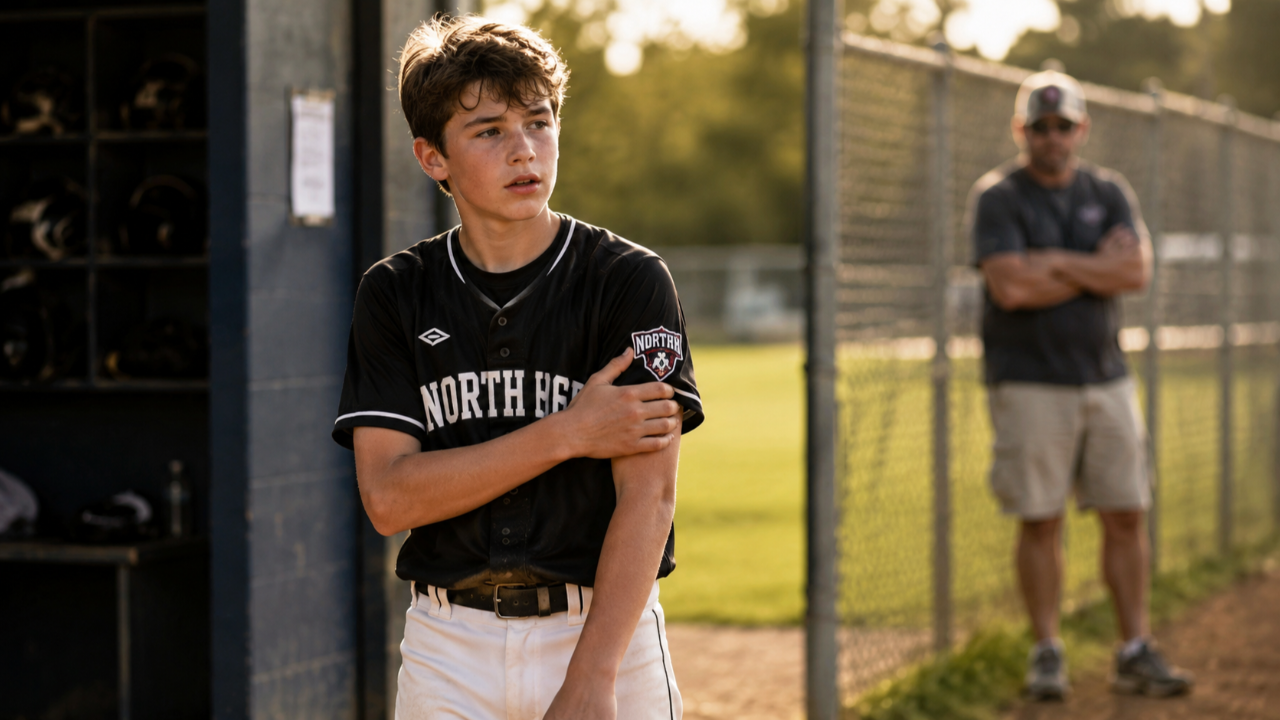
You've been tracking your pitcher's development for years. Then comes the growth spurt — four inches in eight months, shoes that don't fit, sleeves that were long last season — and right in the middle of it, the arm starts sending signals it never sent before. He mentions it after the game. You notice him shaking it out between pitches. Warmup takes longer. The arm looks heavier than it used to.
Something is different. And you don't know whether this is the growth talking, or whether something is actually wrong.
Here's what most parents don't get told directly: arm discomfort during rapid growth is genuinely common, and it has a specific cause that is different from the mechanism behind a typical overuse injury. That difference changes what you do next — and it changes it significantly.
This post gives you the filter. Not a diagnosis — that's what a sports medicine professional is for. A clear way to read what you're seeing, decide how seriously to respond, and know when the arm is telling you something that needs more than a lighter week.
"He grew four inches in one season and his arm started acting up right in the middle of it. Nobody told me those two things might be connected — or what to do about it."
— Parent of a 14-year-old pitcher, travel ball
What Causes Arm Pain in a Youth Pitcher During a Growth Spurt?
Growth spurt arm pain in youth pitchers happens because bone lengthens faster than the surrounding tendons and ligaments can adapt — creating a temporary mismatch between the arm's structure and the stress it's being asked to handle.
When the humerus grows rapidly, the tendons and ligaments attached to it don't lengthen at the same rate. The result is increased tension throughout the arm — tighter than usual across normal ranges of motion, less efficient at distributing the rotational forces of a throwing motion. The same throwing volume that felt manageable three months ago creates more cumulative stress on a growing arm because the mechanics of force transfer have shifted.
Two additional factors compound this during growth spurts. First, the growth plates are more active: the proximal humeral physis — the growth plate at the top of the humerus associated with Little League shoulder — and the medial epicondyle apophysis at the elbow linked to Little League elbow are both structurally softer during rapid growth. They're doing the work of bone lengthening, which leaves them less resilience for absorbing throwing stress. Second, there is a coordination lag: your pitcher's brain has a learned map for generating a throwing motion from his body's proportions. When those proportions change — longer levers, different arm weight, shifted center of gravity — the system recalibrates. That recalibration adds inefficiency per throw, which increases arm stress even when pitch count looks normal.
Research from the American Sports Medicine Institute (ASMI) consistently identifies rapid growth as an independent risk factor for overuse injuries in youth pitchers, separate from and additive to pitch count. For a closer look at how a growth spurt specifically changes throwing mechanics, the page on how growth spurts change a youth pitcher's arm covers that mechanical side of the transition.
What Is the Arm Actually Telling You When the Growth Rate Spikes?
During a growth spurt, the arm communicates through stiffness and diffuse heaviness more than through sharp pain — a different signal pattern than the one that typically signals a structural problem.
What growth-spurt arm signals tend to look like in practice:
Diffuse, not localized. The discomfort spreads across a broad area — "the whole upper arm," "kind of stiff everywhere," "just heavy" — without pointing to a single spot the pitcher can identify with one finger. When you ask where it hurts and he gestures at the general area rather than pressing on a precise point, that's diffuse.
Stiffness-based, not sharp. The arm feels slower to warm up, requires more throws to feel loose, seems to have less elasticity than it did a few months ago. This is the new-proportions effect — the arm is doing more work per throw while it recalibrates.
Variable day to day. Better on lighter days, more noticeable after high-intensity sessions or back-to-back throwing. That variability is actually a useful signal — it means the arm is responding to load and recovering, not stuck in a fixed injury pattern.
Tied to growth happening elsewhere. Growing pains in the legs, rapid shoe size changes, height jumps you can measure week to week. When multiple growth signals are present simultaneously, arm stiffness during that window has different context than arm stiffness in a non-growth period.
These patterns — the Shoulder Shrug, the Stiff Turn, the arm that takes longer than usual to loosen — show up during growth spurts not because something is wrong structurally, but because the arm is working harder per throw while the proportions resettle. The signal is real. The interpretation of it changes when you know why it's showing up.
How Is Growth Spurt Arm Pain Different From a Real Throwing Injury?
The clearest distinction is location and timing — growth spurt discomfort is diffuse and appears after throwing, while a structural injury is localized to a specific point and often present during the motion itself.
A four-part filter parents can apply without medical training:
Location: Diffuse vs. specific. Ask your pitcher to point to where it hurts. If he gestures broadly at the whole arm — "kind of everywhere around here" — that's diffuse. If he places one finger on a precise spot and holds it there, that's localized. Localized pain in a growing pitcher is a different conversation than diffuse stiffness, every time.
Timing: After vs. during. Soreness that shows up in the evening after a game, or the morning after a bullpen, is a different signal than pain that appears during the throwing motion — on delivery, at release, or during warmup. Growth-related discomfort is mostly after. Injury-related pain is often during.
Recovery: Resolves vs. persists. Diffuse growth stiffness typically clears within 24 to 48 hours of genuine rest. If the arm resets after a real off-arm day, that's consistent with growth stress. For a full breakdown of how to read recovery timelines, the guide on arm soreness vs. pain in youth pitchers covers the specific windows to watch.
Character: Heavy vs. sharp. Heaviness, tightness, sluggishness are growth-spurt words. Sharp, biting, stabbing are different words for a different category of signal.
Two exceptions worth naming directly: medial elbow pain — on the inner bony prominence — that a pitcher can point to with one finger is Little League elbow territory, not "just growth," even during an active growth spurt. And outer upper arm pain near the shoulder joint that doesn't resolve with rest is Little League shoulder territory. Growth spurts increase vulnerability to both — they don't make those signals acceptable to push through. And as growth plates close in older adolescent pitchers, the medial elbow risk shifts: what was apophysis stress becomes UCL stress. That's why understanding the early Tommy John warning signs matters most in the 14–17 window, when skeletal maturity is transitioning and the risk profile of medial elbow pain changes character.
What's the Right Response — and Why It Probably Isn't Shutdown?
The right response to growth-spurt arm discomfort is workload adjustment, not shutdown — the arm is doing real work during a growth phase, but it needs more recovery space around that work, not necessarily an end to throwing.
This is the decision most parents get wrong in both directions. Some push through because nothing is "officially wrong." Others panic-shutdown because something feels different. Both miss the actual management lever, which is adjusting the week's load and recovery structure.
What adjustment looks like in practice during a growth phase:
Volume: pull back total weekly throwing. Not to zero — to a lighter version of what was already planned. Fewer mid-week bullpen sessions. Shorter long-toss distances. Less overall time under load during the most active growth weeks.
Intensity: protect from max-effort sessions. Showcases, back-to-back tournament starts, and high-intensity bullpen work ask the most of the arm's force-transfer system — exactly what is under the most stress during rapid growth. These are the sessions worth delaying or softening, not necessarily eliminating.
Recovery: honor the 48-hour window. Build in one genuine off-arm day per week. During a growth spurt, that day is not optional recovery — it's required maintenance for an arm that is working harder per throw than it was two months ago.
The Green / Yellow / Red framework applies directly here. Green: diffuse stiffness, resolves within 48 hours, not escalating week over week — maintain current load or progress conservatively. Yellow: stiffness carrying past 48 hours, arm taking longer to loosen each session, Shoulder Shrug or Stiff Turn showing up more consistently — reduce the week's volume, add recovery space, watch for one week before adjusting further. Red: localized pain, sharp character, present during the throwing motion — stop the session and get an evaluation.
Not sure if what you're seeing this week is normal growth discomfort — or a signal to pull back?
The 2-Minute Arm State Check walks through 8 questions about what your pitcher's arm is doing right now and gives you a Green, Yellow, or Red read with a clear recommendation for the week ahead.
Take the Free Arm State Check →When Should Growth Spurt Arm Pain Prompt a Professional Evaluation?
Seek a professional evaluation when arm pain is localized to a specific point, present during the throwing motion rather than only after it, or not improving after a full week of meaningfully reduced throwing load.
The growth spurt context changes the baseline for diffuse soreness. It does not change the threshold for these specific signals:
Medial elbow tenderness the pitcher can point to with one finger — especially on the inner bony prominence at the elbow. This is the location associated with Little League elbow, a growth plate stress injury that doesn't improve with continued throwing regardless of whether a growth spurt is occurring.
Outer upper arm or proximal shoulder pain that persists through rest days — doesn't clear within 48 hours, shows up at progressively lower throwing intensities, or is present at rest as well as after throwing. This is Little League shoulder territory. Growth spurts make pitchers more vulnerable to it, not less.
Velocity drop that doesn't return after a genuine week of reduced load. A growing arm that drops 3–5 mph during an especially active growth week and then normalizes is showing normal variability. A velocity drop that holds across two or three weeks of genuinely lighter load is showing something else.
Any sensation the pitcher describes as sharp, popping, or locking — regardless of whether it happens every throw or only once. Once is enough to get eyes on it.
The ask is not to become a diagnostician. It's to know which signals the growth spurt frame doesn't explain — and to seek evaluation when those signals appear, rather than attributing everything to growth and waiting.
What Should You Watch for Week to Week During a Growth Phase?
Track how the arm recovers between throwing sessions, not just how the pitcher performs during them — a growing arm adjusting normally shows variability across weeks, not consistent escalation.
Three questions worth asking consistently each week during a growth phase:
Is the arm recovering within 24 to 48 hours? Diffuse stiffness that clears by the next morning — or at most by the day after — is consistent with normal growth stress. Stiffness that is still present at 72 hours means the session asked more of the arm than it could absorb at this point in the growth window. Reduce the next session before adding more demand.
Is the sensation getting louder, quieter, or holding steady over the past three to four weeks? A growing arm in healthy adjustment tends to show variable weeks — tougher during a rapid growth stretch, then calmer as the rate settles. What it doesn't show is a consistent one-direction escalation. If the arm is noticeably worse this week than three weeks ago and the load hasn't increased, the growth frame doesn't fully explain what's happening.
Is the discomfort staying diffuse, or sharpening and localizing over time? Diffuse stiffness that stays diffuse is growth. Stiffness that concentrates into a specific spot over several weeks, or that sharpens in character rather than just varying in intensity, is a different direction. That pattern warrants a closer look regardless of whether a growth spurt is active.
For a structured way to make these week-to-week arm decisions across a full season, the guide on growth spurts and youth baseball arm pain covers the decision framework in more detail.
A growth spurt and an arm injury are not the same thing. The discomfort that comes with rapid bone growth is real — but it's manageable with the right adjustment. The patterns that signal something structural are different in location, character, and timing, and they don't disappear just because growth is happening.
The arm will tell you. Growth-phase signals are usually diffuse, variable, and recovery-responsive. Injury signals are usually localized, consistent, and motion-triggered. Put that filter on what you're seeing — and then decide what this week actually asks of you.
If you're still unsure where your pitcher's arm sits after reading this, the questions below are the most common ones parents bring — and the check after them gives you a structured read in about two minutes.
Frequently Asked Questions About Youth Pitcher Arm Pain and Growth Spurts
Can a growth spurt cause arm pain in a youth pitcher?
Yes — growth spurts are a recognized independent risk factor for arm discomfort and overuse injury in youth pitchers. When the humerus lengthens rapidly, the tendons and ligaments attached to it do not adapt at the same rate. The result is increased tension throughout the arm, reduced efficiency in distributing throwing forces, and temporarily more vulnerable growth plates. The discomfort that results is real, but it has a different character and cause than a structural throwing injury.
How long does arm pain from a growth spurt last?
Growth-related arm discomfort typically tracks with the growth rate itself — most pronounced during the fastest growth weeks, then settling as the rate slows and the arm's structure adapts. For most youth pitchers, a notable growth window lasts 4 to 12 weeks. Diffuse stiffness that clears within 24 to 48 hours of rest is consistent with growth stress and should resolve as the arm recalibrates. Discomfort that escalates, localizes to a specific point, or doesn't recover with rest in that window is a different category of signal.
Should a youth pitcher rest during a growth spurt?
Shutdown is rarely the right response to growth-phase arm discomfort — adjustment is. Practical adjustments include reducing total weekly throwing volume, avoiding max-effort sessions during the most active growth weeks, and honoring a genuine 48-hour recovery window between high-demand sessions. One off-arm day per week is a minimum effective rest structure during active growth. Reserve full shutdown for pain that is localized, sharp, present during throwing, or not resolving with reduced load after a week.
What is the difference between growth spurt arm pain and Little League shoulder?
Growth spurt arm discomfort is diffuse — a broad, stiffness-based heaviness the pitcher cannot point to with one finger, and that resolves with 24 to 48 hours of genuine rest. Little League shoulder is a growth plate stress injury at the top of the humerus that is localized to a specific point in the outer upper arm and shoulder area, often does not fully resolve with short rest windows, and typically requires imaging to confirm. Growth spurts make pitchers more vulnerable to Little League shoulder — the two are related in risk, but different in severity and required response.
When should I take my pitcher to the doctor for growth spurt arm pain?
Seek evaluation when arm pain is localized to a specific point the pitcher can identify with one finger, present during the throwing motion rather than only after it, not improving after a full week of meaningfully reduced load, or accompanied by swelling, visible asymmetry between arms, or any sensation described as sharp, popping, or locking. Medial elbow pain and outer upper arm or shoulder pain that persists through rest days should always be evaluated — growth context does not change the threshold for those specific signals.
You know how to recognize the signals. Now get a personalized read on what his arm is actually doing right now.
The Arm State Read walks through your pitcher's specific situation — what the signals mean for his arm this week, and exactly what to do about them. Not a general guide. A read on his arm.
Get the Arm State Read →$27 · Delivered same day