
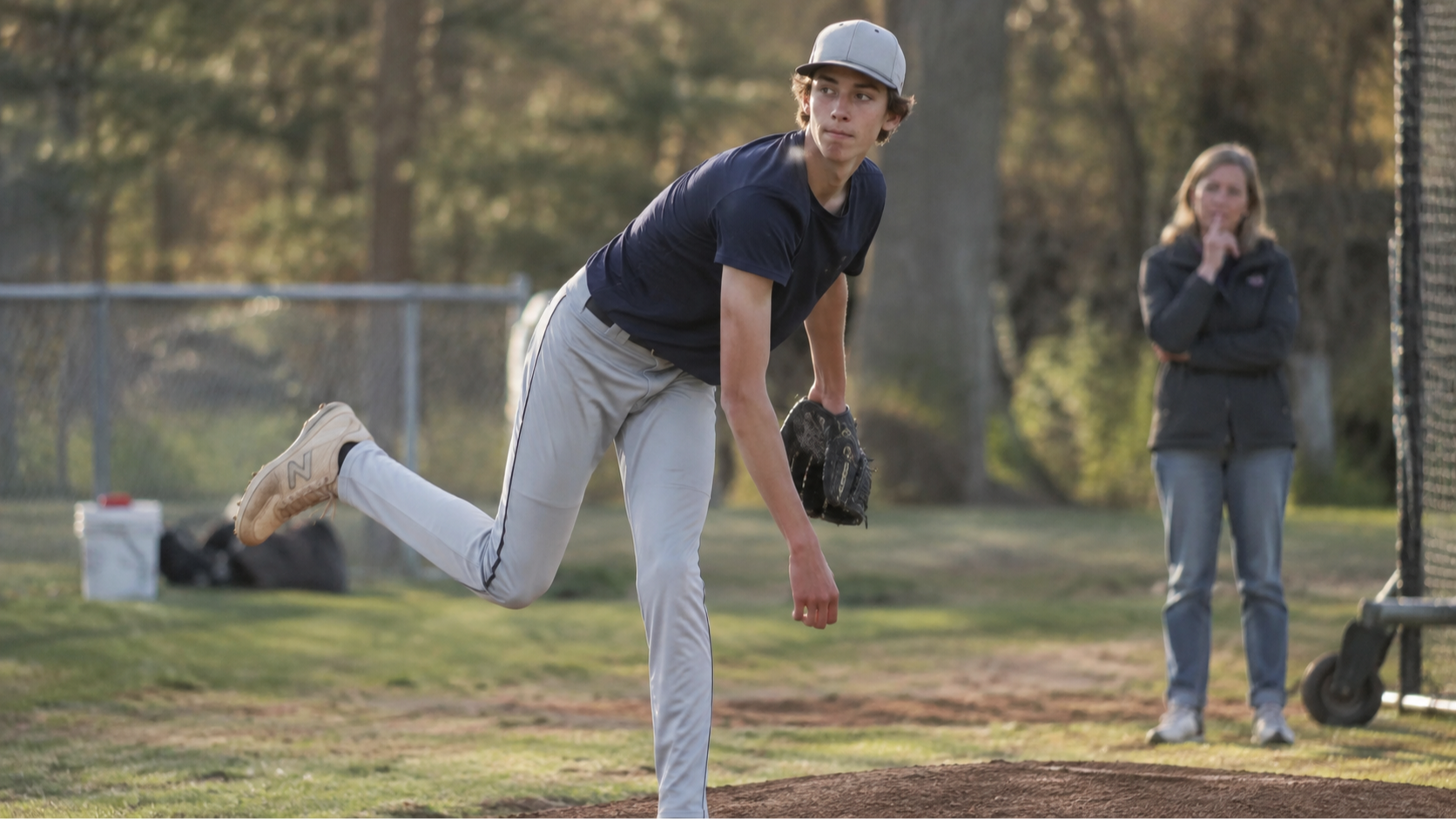
His mechanics suddenly look wrong. Before you call the pitching coach, check if he just grew.
A parent's guide to youth pitcher growth spurt changes — why velocity drops, why the delivery looks off, and what to do about the throwing schedule while it's happening.
By Joey Myers · VeloRESET · Youth pitcher arm care specialist · 20+ years working with youth athletes
The youth pitcher growth spurt is one of the most misread phases in youth baseball. Velocity dips. Command disappears. The delivery looks choppy or disconnected. Everything the pitcher worked on seems to be gone. The natural response for most parents and coaches is to treat this as a mechanics problem — add more reps, fix the arm path, get back to the pitching coach. But during an active growth spurt, that response often makes things worse. Understanding what the arm is actually doing during rapid growth is the first step toward managing the phase correctly — and protecting the arm while it's at its most vulnerable.
Unsure if what you're seeing is growth-related or something more? Get an Arm State Read →
What does a youth pitcher growth spurt actually do to the throwing motion?
During a growth spurt, the entire movement system is recalibrating to a body that has physically changed — often faster than the nervous system and connective tissue can keep pace with.
Here's the mechanism: bones lengthen at a faster rate than the surrounding tendons, ligaments, and muscles can adapt. A pitcher's arm is literally longer than it was two months ago — but the neuromuscular patterns governing the delivery were calibrated to the old arm length. Additionally, the muscles become temporarily tighter as bone length outpaces soft tissue adaptation, which reduces flexibility and increases the pulling force on growth plates at the attachment sites. The result is a body that looks and feels different under the same throwing conditions it handled comfortably six months ago.
For youth pitchers, this shows up as a simultaneous change in multiple things at once: release point shifts, hip-shoulder sequencing feels disconnected, timing is off, arm action looks longer or shorter depending on the day. None of this is the pitcher doing something wrong. The body is compensating for a structural change it hasn't finished processing yet. However, pushing high-effort throwing into that window adds stress to tissues that are already under increased load from the growth itself.
Why does velocity drop during and after a youth pitcher growth spurt?
A velocity drop during a growth spurt is a coordination and timing issue, not a strength or mechanics failure — and understanding the difference changes how you respond to it.
When the arm gets longer, the existing motor patterns — the neurological blueprint the pitcher has spent years building — no longer match the new lever arm. The sequencing that produced efficient power transfer with the old arm length now fires at slightly wrong timing intervals with the longer one. Velocity drops because power transfer efficiency drops while the nervous system updates its patterns to the new body. Therefore, a velocity drop during a known growth phase is typically a signal that development is proceeding normally, not that something has gone wrong.
The more important concern isn't the velocity number — it's that a longer arm with the same workload creates more stress per throw than it did before the growth spurt. ASMI's youth baseball research and broader adolescent sports medicine data consistently show that the structural load on growth plates increases during peak height velocity even when pitch counts stay exactly the same. In other words, following the same schedule during a growth spurt means the arm is doing more work than it was before — not less.
Why growth spurt mechanics look like a technique problem — and why fixing them can backfire
The changes a youth pitcher growth spurt produces look identical to mechanical errors — and that's exactly what makes this phase so easy to mismanage.
A shortened arm path, altered release point, disconnected hip-shoulder sequence, inconsistent command — these are the same things a pitching coach corrects in a pitcher who has developed bad habits. But when those same observations appear during an active growth spurt, the cause is structural, not technical. The pitcher hasn't developed a bad habit. The arm is longer than it was last month, and the existing delivery pattern doesn't fit the new geometry yet.
Aggressive mechanical correction during this phase — more reps, more intensity, more mound work to "fix" what's observed — loads the arm at a time when its structural tolerance is already reduced. Research tracking adolescent athletes has found that injury risk spikes 31 to 53 percent in the six months following an athlete's growth spurt. Athletes growing faster than approximately three inches per year face 74 percent higher injury risk regardless of sport. The arm during a youth pitcher growth spurt is not a broken delivery that needs more work. It's a system adjusting to a changed body that needs time and reduced load.
The most protective thing a parent can do during this window is resist the instinct to add volume or fix mechanics intensively, and instead reduce competitive throwing load while allowing the body to calibrate on its own timeline.
When does injury risk actually increase during a youth pitcher growth spurt?
Injury risk during a growth spurt peaks not because the athlete is doing something new or different — but because the same activity now places higher structural stress on tissues that haven't yet adapted to the changed body.
The growth plates (apophyses) are made of cartilage that is weaker than bone. During rapid growth, muscles and tendons tighten as bone length outpaces their ability to adapt — which increases the pulling force on those growth plate attachment sites with every throw. The two most common overuse injuries in this window are Little League Elbow (medial epicondyle apophysitis — irritation at the growth plate on the inner elbow) and Little League Shoulder (proximal humeral apophysitis — growth plate stress at the shoulder). Research indicates approximately 25 percent of youth pitchers and 58 percent of high school pitchers experience medial elbow pain at some point. These injuries often appear to come "out of nowhere" — because the throwing program didn't change. The arm underneath it did.
Research finding: Injury risk spikes 31–53% in the six months following peak height velocity — even when the throwing program stays exactly the same.
Additionally, 70 percent of UCL injuries occur before age 20, and more than half of professionals who eventually required elbow surgery had elbow problems as youth players. The growth spurt window is one of the highest-risk periods in a pitcher's entire career — and it typically passes with no formal recognition from any official guideline system, because pitch count rules don't adjust for growth.
"What I appreciate most is not being in a guessing game. We're not just waiting and hoping. We understand what we're seeing."— George R., Josh's dad · pitcher & middle infield, high school freshman
"The biggest thing Joey's taught me isn't a swing cue. It's how to read what your body is telling you before it shuts you down."— Drake Davis · 1B/OF, Fresno City College · .381 AVG, 12 HR, 53 RBI · 2025 Freshman of the Year
Not sure if what you're seeing is growth-related or something more?
The Arm State Read helps you understand where the arm actually stands — so you're not making schedule decisions in the dark.
Get Your Arm State Read →How should the throwing schedule change during a youth pitcher growth spurt?
The core adjustment during a youth pitcher growth spurt is simple: reduce competitive throwing load while maintaining movement quality through lighter activity.
This doesn't mean shutting the pitcher down entirely. It means recognizing that the arm's structural tolerance is temporarily lower and adjusting accordingly. Practically, that looks like: fewer competitive bullpen sessions per week, lighter effort on sessions that do happen (closer to 65–75 percent intensity rather than full competitive effort), prioritizing movement quality over velocity or command outcomes, and extending warmup time before any session to account for the increased muscle tightness that typically accompanies rapid growth.
For specific youth pitcher bullpen frequency guidance — how often to throw bullpens and how to structure the week around games during this period — that framework applies with an additional consideration: during growth, the conservative end of any recommendation is the appropriate starting point. One fewer bullpen per week during a known growth phase is a workload decision with real protective value.
The arm readiness check is particularly useful during growth spurt phases because it accounts for how the arm actually feels and moves rather than just what the schedule says. Growth spurt arms frequently read yellow or red on the readiness check even during weeks with normal pitch counts — because the structural stress per throw is higher than the numbers reflect.
What signals tell you the growth spurt is affecting the arm versus a real injury?
The distinction between normal growth-related changes and a developing injury isn't always clean — but several signals help separate the two.
Growth-related changes tend to affect multiple things simultaneously: velocity and command decline together, the delivery looks different across multiple sessions, and the arm feels "different" rather than painful. These changes appear alongside a visible growth phase — the pitcher has grown noticeably in height in recent months — and tend to improve gradually as the body adapts. With reduced workload and time, the arm finds its new pattern. This is a coordination and adaptation process, not a structural failure.
Injury signals are more specific and localized: pain at a specific point on the elbow (particularly the inner elbow, at the medial epicondyle), pain that appears during throwing and persists afterward, soreness lasting more than 48 hours after a session, or any loss of range of motion that doesn't resolve with warmup. These signals warrant medical evaluation, not just a schedule adjustment.
The most important practical rule: growth-related changes affect performance (velocity, command, timing) but should not produce localized joint pain. When pain appears at a specific point — especially inner elbow pain in a growing pitcher — that's a signal to stop throwing and get evaluated, not to adjust the schedule and continue. Understanding when to give the arm a full rest versus when to reduce load and continue is the core decision parents need to make correctly during this phase.
Frequently Asked Questions
Is it normal for a youth pitcher to lose velocity during a growth spurt?
Yes — a velocity drop during a youth pitcher growth spurt is a common and typically normal part of the growth process. When the arm gets longer, the existing motor patterns no longer match the new lever arm. The sequencing that produced efficient power transfer with the old arm length now fires at slightly off timing intervals with the longer one. Velocity drops while the nervous system updates its patterns to the new body geometry. In most cases, velocity returns and often exceeds previous levels once the body has adapted. The concern is not the velocity number during growth — it's managing the arm appropriately during the adaptation window.
Why do a youth pitcher's mechanics suddenly look wrong during a growth spurt?
Mechanics look wrong during a growth spurt because the body the pitcher has been training in has physically changed — but the neurological movement patterns haven't caught up yet. Release point shifts, altered hip-shoulder sequencing, and inconsistent arm action are all normal expressions of a longer limb operating on patterns calibrated to a shorter one. These changes look identical to mechanical errors, which is why the instinct is often to add mechanical correction work. However, during an active growth spurt, aggressive mechanical drilling loads the arm at a time when its structural tolerance is already reduced by the growth itself. Time and reduced workload typically resolve these changes as the body adapts.
How much does injury risk actually increase during a youth pitcher growth spurt?
Research tracking adolescent athletes consistently shows injury risk spikes 31 to 53 percent in the six months following peak height velocity — the period of most rapid growth. Athletes growing faster than approximately three inches per year face 74 percent higher injury risk regardless of sport. For pitchers specifically, this is compounded by the fact that the same pitch count creates more structural stress per throw during a growth spurt, because bones are longer while tendons and ligaments haven't fully adapted. Pitch count guidelines don't adjust for this — which means the official rules can indicate normal workload while the arm is experiencing meaningfully higher-than-normal stress.
Should a youth pitcher rest completely during a growth spurt?
Complete rest isn't usually necessary unless the arm is showing injury signals. The more appropriate adjustment is a reduction in competitive throwing load — fewer high-effort bullpen sessions, lighter intensity on sessions that do happen, and extended warmup to account for increased muscle tightness during rapid growth. Maintaining light movement through the arm is generally preferable to complete shutdown, which can create reconditioning challenges when activity resumes. The goal is to keep the arm moving at lower stress levels while giving the body time to adapt to its new geometry.
How do I tell the difference between a growth spurt change and Little League Elbow?
Growth-related changes tend to affect performance across the board — velocity, command, and timing all shift simultaneously — without localized joint pain. Little League Elbow produces a specific signal: pain at or around the medial epicondyle on the inner side of the elbow, which typically worsens with activity and may persist for several days after throwing. Growth changes affect how the pitcher looks and how the arm feels generally. Little League Elbow produces a distinct, localized pain at a specific anatomical site. If a growing pitcher reports inner elbow pain during or after throwing — particularly if it's a new symptom that didn't exist before the growth spurt — that warrants a medical evaluation rather than a schedule adjustment.
How long does the adjustment period last after a youth pitcher growth spurt?
The adjustment period varies considerably by athlete and by the rate of growth. Generally, the most disruptive phase corresponds with the period of most rapid height gain — often four to eight months at peak height velocity — and the coordination and timing recalibration that follows can take several additional months. Pitchers who experience rapid growth (more than two to three inches in a short window) often take longer to fully re-coordinate than those with slower, steadier growth. The practical guideline is to manage workload conservatively until the pitcher demonstrates consistent velocity, command, and movement quality at lower-effort sessions before returning to full competitive throwing loads.
Do pitch count guidelines protect youth pitchers adequately during a growth spurt?
No — standard pitch count guidelines don't account for growth at all. The same pitch count limit applies whether a pitcher is mid-growth spurt or fully skeletally mature. But during a growth spurt, each throw creates more structural stress than it did before growth began, because bones are longer while tendons and ligaments haven't yet adapted. A pitcher following all pitch count rules can still be accumulating more arm stress than the numbers reflect during an active growth phase. This is why readiness-based evaluation — looking at how the arm actually feels and moves, not just what the pitch count says — becomes especially important during this period.
Want a clearer framework for managing the arm through this phase?
Chapter 1 of the free VeloRESET guide walks through how to structure the throwing week during growth phases — including how to recognize when the arm is telling you to pull back before something becomes a real problem.