Youth Pitcher Arm Soreness vs. Pain: How to Tell the Difference
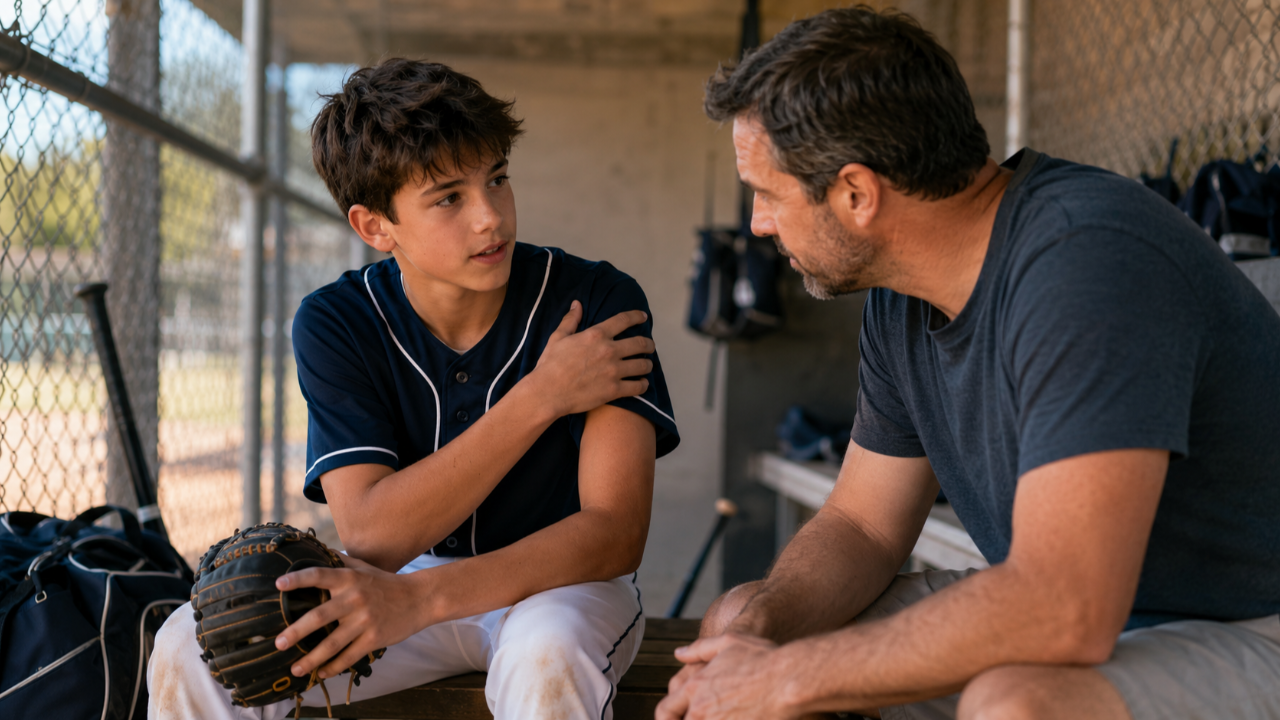
Not Sure If It's Soreness or Something More? Here's the Question That Actually Matters.
You're standing in the parking lot after the game, watching your pitcher shake out his arm on the way to the car. He says he's fine. He always says he's fine. But something in the way he's moving — or something in the way he said it — has you thinking.
"I don't know if I'm being paranoid or if something's actually wrong."
That thought lives in the space between soreness and pain. And most parents spend more time there than anyone talks about. The problem isn't that you're anxious. It's that nobody has given you a clear way to think about the difference — or more importantly, what that difference actually asks you to do this week.
This post won't give you a definitions list. It will give you a decision process: one question that separates soreness from pain, and a clear path for what each answer means for your pitcher's next few days of throwing.
What Is the Difference Between Arm Soreness and Arm Pain in Youth Pitchers?
Arm soreness in youth pitchers is diffuse, dull, and time-responsive — it shows up after a session, spreads across a broad area, and fades within 24 to 48 hours of genuine rest. Arm pain is localized, sharp, and motion-triggered — it lives in a specific point, often arrives during the throwing motion itself, and does not reliably fade on a normal recovery timeline.
That's the technical answer. Here's why it matters in practice.
Soreness is the arm telling you it worked hard. Pain is the arm telling you something is being asked of it that it can't currently handle. Both are forms of communication. The mistake most parents make isn't ignoring one of them — it's treating them identically, or panicking at both. Neither response serves the pitcher.
Understanding normal soreness in youth pitchers is the starting point. But knowing what to do once you've placed the feeling in one category or the other — that's the part that actually changes the week.
The One Question That Separates Soreness From Pain
Ask your pitcher one question — not after the game, but the morning after, when the arm has had time to respond to what was asked of it:
"Where exactly does it feel off — and does it feel that way when you're just sitting here, or only when you throw?"
Location and timing. Those two pieces of information tell you nearly everything you need to make a clear decision.
If the feeling is vague and widespread — "the whole arm," "kind of stiff," "just tired" — and it's not present at rest, you're most likely looking at soreness. That's a Yellow signal: worth noticing, not worth alarming yourself over. The arm is asking for space, not shutdown.
If the feeling is specific — "right here," with a finger pointing to a precise location — or if it shows up during the motion itself (mid-throw, on release, or during warm-up) rather than only after, you're likely looking at a pain signal. That's a Red signal. The arm is asking for something that a few easy days won't resolve on their own.
This distinction isn't about diagnosing your kid. It's about categorizing what you're seeing so you can make a calmer, clearer call about what this week should look like.
When Should Arm Soreness Change What You Do This Week?
Arm soreness should adjust your week when it's still present 48 to 72 hours after the last throwing session, when it appears earlier in outings than it used to, or when your pitcher is mentioning it more consistently than before — even if the words are casual.
Soreness that resolves on a normal timeline (24–48 hours of rest) with no other signals is generally a Green-to-Yellow response: the arm worked hard, recovered, and is ready to work again. No intervention needed beyond honoring the recovery window.
Soreness that lingers past 72 hours, or that shows up before your pitcher has even done anything demanding, is the arm's way of telling you the recovery deficit is accumulating. That's the moment to pull back — not shut down, but reduce the load for the week and watch whether the arm normalizes before adding demand again.
The pattern to watch for is a change in baseline. If your pitcher's arm has felt a certain way for weeks and that shifts — either getting louder or showing up earlier — that change is the signal, independent of the exact words he uses to describe it.
What Arm Pain in Youth Pitchers Actually Means for This Week
Sharp or localized arm pain in a youth pitcher means this week's throwing plan changes — not necessarily to zero, but to a deliberate reduction in intensity and close observation of whether the signal quiets or escalates.
The common sites for localized pain in youth pitchers are the medial (inside) elbow — the most frequent location for growth-plate stress in pitchers ages 10–15 — the posterior (back) shoulder, which carries the load of arm deceleration after every pitch, and the outer upper arm near the shoulder joint, where Little League shoulder growth-plate stress accumulates in pitchers ages 11–16. Sharp sensation at any of these locations during a throwing motion is not something to work through.
"Coach says he's fine, but I'm not totally convinced." If that's the feeling you're sitting with after a coach or trainer has cleared your pitcher to throw, the question worth asking is: cleared by what standard? Cleared from a medical standpoint — meaning no fracture, no acute tear — is not the same as ready to throw at full demand. "Cleared ≠ Ready" is one of the most important distinctions in youth baseball arm health, and it's one the delivery system rarely explains clearly to parents. If the soreness is specifically on the inside of the elbow and is present during throwing rather than only after, it's also worth understanding what actually increases Tommy John risk in youth pitchers — the signals that precede UCL stress are readable, and inner-elbow pain during throwing is on that list.
If you're seeing localized pain that is motion-triggered and not resolving within a normal rest window, that warrants a conversation with a sports medicine professional who works with youth pitchers specifically. Not to alarm you — to get clarity before the decision gets harder.
Growth spurts add an additional layer of complexity to this picture. During rapid bone lengthening, a growing arm produces a baseline signal pattern — diffuse stiffness, slower warmup, heavier feel — that can look like fatigue but has a different cause. The filter above still applies, but the baseline shifts: some diffuse soreness during an active growth spurt is the arm recalibrating, not accumulating injury. For a full look at how to read arm signals in a growth-phase context, and where the distinction between growth stress and real injury sits, see the guide on youth pitcher arm pain during a growth spurt.
Why This Distinction Is Hard to Make in Practice
Most parents know the difference between soreness and pain in theory. The difficulty is that youth pitchers are not reliable reporters. They understate because they want to play. They overstate when they're anxious about something unrelated. And they often genuinely can't locate the distinction themselves — they just know "something feels off."
"I don't want to overreact, but I also don't want to ignore it." That sentence describes most parents in this position exactly. And it's a reasonable place to be, because the stakes feel real on both sides — push too hard and risk something serious, pull back too soon and you've created a new anxiety about the arm that might not be warranted.
The place where most parents get stuck is waiting for certainty before acting. The soreness/pain distinction doesn't give you certainty. It gives you a category — and a category is enough to make a calmer, more deliberate call about this week's throwing plan without having to be a medical professional or a pitching coach.
For a look at the behavioral signals that typically show up before either soreness or pain becomes the conversation, see the six arm signals parents misread — these are the patterns the arm uses to communicate before the feeling is sharp enough to notice.
How to Apply the Green / Yellow / Red Spectrum to Soreness and Pain
Green, Yellow, and Red aren't injury categories — they're readiness categories. They tell you how much demand the arm can handle this week based on what you're observing, not based on a formal diagnosis.
Green: Soreness resolved within 48 hours. No specific location. No motion-triggered feeling. Pitcher reports feeling ready. Add demand normally — the arm handled what was asked and is ready for more.
Yellow: Soreness that lingered past 48–72 hours, or that has been mentioned more than once this week. No sharp or localized feeling. No pain during the motion. Reduce volume for the week — fewer pitches, shorter sessions, no back-to-back outings — and watch whether Yellow moves back to Green over the next few days. Most Yellow weeks resolve to Green with one intentional step back.
Red: Sharp or localized pain at a specific point. Pain present during the throwing motion or in warm-up. Soreness that has not resolved after 72+ hours of rest. Stop adding throwing demand and consult a sports medicine professional before resuming a normal schedule. Red doesn't mean the arm is broken — it means the arm needs more information than a parent or coach can provide on the sideline.
The goal isn't to stay in Green permanently — that's not realistic across a full season. The goal is to respond to Yellow before it becomes Red. That's the entire decision process, week over week.
How to Use This Process This Week
The morning after a game or bullpen session, ask one question: where and when. Get a specific answer on location (diffuse vs. localized) and timing (rest vs. motion). Place what you hear into Green, Yellow, or Red based on that answer. Then adjust the week accordingly — more demand, same demand, or reduced demand.
That's it. You're not diagnosing. You're reading. And reading what the arm is telling you with enough clarity to make a calm, deliberate call is the whole point.
For a broader map of where this week's assessment fits into an ongoing arm health picture, the Arm Care Decision Hub walks through how the soreness/pain distinction connects to workload, recovery, and readiness decisions across a full season.
And if you want to know where your pitcher's arm is sitting right now — not in a general sense, but based on what you're actually seeing this week — the arm fatigue signs to watch page gives you a structured checklist for reading the patterns that show up before soreness and pain become the conversation.
Frequently Asked Questions
What is the difference between arm soreness and arm pain in youth pitchers?
Arm soreness in youth pitchers is diffuse, dull, and resolves within 24 to 48 hours of rest — the arm's normal response to hard work. Arm pain is localized to a specific point, sharp rather than achy, and often present during the throwing motion itself, not only after. Soreness is a Yellow signal: monitor and adjust. Localized or motion-triggered pain is a Red signal: reduce demand and seek evaluation before resuming normal throwing.
How long should arm soreness last in a youth pitcher after a game?
Normal arm soreness in a youth pitcher typically resolves within 24 to 48 hours of genuine rest after a game or bullpen session. Soreness that persists beyond 72 hours, or that is still present the morning before a pitcher's next scheduled outing, is a sign that recovery is running behind demand. That pattern — not the soreness itself — is the signal worth acting on.
My son says his arm is fine but something still feels off to me. What should I do?
Trust the pattern more than the report. Youth pitchers often understate arm issues because they want to play, and they adapt to low-level discomfort without realizing it. If you're noticing behavioral signals — he's shaking the arm out between pitches, command has dropped, he mentions the arm more casually than before — those observations are real data. Ask the location-and-timing question the morning after a session: where exactly does it feel off, and does it feel that way at rest or only when throwing? That answer will tell you more than "I'm fine."
When should I have a sports medicine professional evaluate my youth pitcher's arm?
Seek a professional evaluation when arm discomfort is localized to a specific point (especially the medial elbow or posterior shoulder), when it is present during the throwing motion rather than only after, or when soreness has not resolved after 72 or more hours of genuine rest. You do not need to wait for a dramatic event. Sharp, specific, or motion-triggered pain is reason enough to get clarity before the arm is asked to do more.
Is it safe for a youth pitcher to throw through arm soreness?
Diffuse, post-session soreness that resolves within 48 hours is generally not a reason to stop throwing — but it is a reason to honor the recovery window before adding more demand. A pitcher who is still sore on Monday should not be throwing a full bullpen on Tuesday. Throwing through soreness that has not resolved is how a Yellow signal becomes a Red one. The decision is not "throw or don't throw" — it is "how much, and starting when."
Is what you're seeing right now soreness or something that needs more attention?
The free 2-Minute Arm State Check gives you a Green, Yellow, or Red read on your pitcher's arm — based on what you're actually observing this week — and a clear recommendation for what to do next.
Take the Free Arm State CheckTakes about 2 minutes. No purchase required.