His Growth Plates Are Still Open: And That Changes Everything About How His Arm Handles A Throw
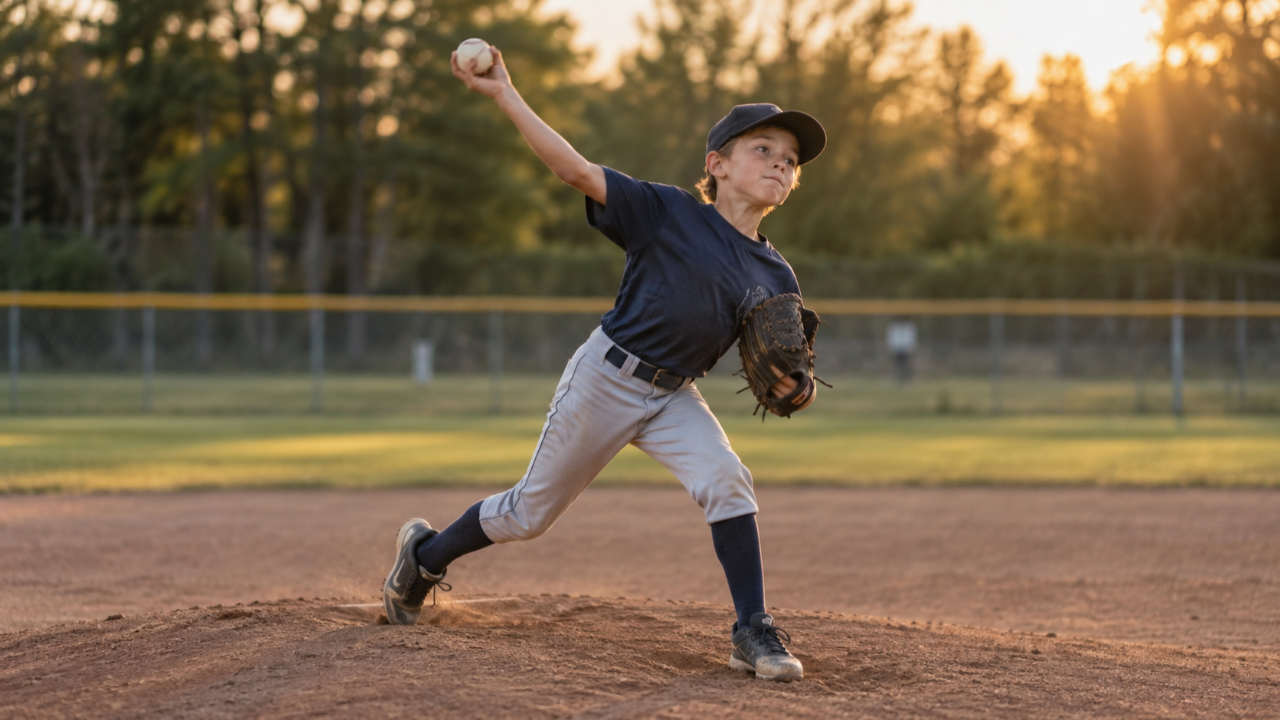
Somewhere in a conversation about his arm — a doctor's visit, a guide you read at 11 p.m., a coach explaining why he's being held out — the phrase "growth plate" came up. Maybe it was explained. Maybe it was said quickly, in passing, and you nodded because asking felt like it would slow things down.
Growth plates in youth pitchers are the reason a 12-year-old's arm and a 22-year-old's arm respond to the exact same throwing workload differently — not a little differently, structurally differently. Understanding what they are isn't optional background reading. It's the piece that makes every other arm-health decision — rest, return-to-throw, when to worry, when not to — actually make sense instead of feeling like a set of arbitrary rules.
This guide explains what a growth plate is, where they sit in a pitcher's elbow and shoulder, when they close, and why that single fact underneath both Little League elbow and Little League shoulder changes how you should think about his arm during these years.
I'm Joey Myers. I built VeloRESET because I kept watching parents get handed conclusions — "rest him," "he's fine," "watch it" — without ever being given the one piece of anatomy that explains why those conclusions matter in the first place.
"The doctor pointed at the X-ray and said something about a growth plate. I just nodded. I didn't want to ask what that actually meant in front of my son."
— Parent of an 11-year-old pitcher, rec league
What is a growth plate, and why does it matter for a youth pitcher?
A growth plate — the medical term is physis — is a layer of developing cartilage near the end of a child's or adolescent's bones. It's the site where new bone tissue is produced as a young athlete grows taller and his skeleton lengthens. Once growth is complete, the cartilage hardens into solid bone and the growth plate closes for good.
Until that happens, growth plates are the softest, least mature tissue in a young pitcher's arm — weaker than the surrounding bone, and in some spots weaker than the ligaments and tendons attached to them. That matters directly for throwing, because pitching places repeated tensile, rotational, and compressive forces on the elbow and shoulder, and those forces land somewhere. In an adult, they're absorbed mostly by hardened bone and mature connective tissue. In a growing pitcher, a meaningful share of that stress reaches tissue that's still cartilage.
That's the whole reason growth plates come up so often in youth pitching arm care. It isn't that a young arm is generically more fragile — it's that one specific structure, at specific locations, hasn't finished becoming bone yet, and throwing repeatedly loads exactly those locations.
Why does a 12-year-old's arm respond to throwing differently than an adult's?
Because the two arms aren't actually made of the same material yet.
An adult pitcher's elbow and shoulder are fully ossified — every growth plate has closed, and the bone that remains is uniformly hard from end to end. When he throws, the stress distributes across mature bone, ligament, and tendon that have finished developing and, in a trained thrower, adapted to the demand over years.
A youth pitcher's arm is a mix of hardened bone and active growth plates that are, tissue-for-tissue, considerably softer. Throw the same pitch at the same effort level, and the youth arm is routing a meaningful portion of that force through cartilage instead of bone. That's not a training deficiency or a conditioning gap you can close with more reps — it's a structural fact of a still-developing skeleton, and it's temporary. Every pitcher's growth plates eventually close. The question is what happens to them between now and then.
Where are the growth plates in a pitcher's throwing elbow and shoulder?
Two locations matter most for throwing injuries, and they correspond directly to the two most common youth pitching injuries.
- The medial epicondyle — the bony bump on the inside of the elbow. This growth plate is under tensile (pulling) stress every time a pitcher throws, because the throwing motion pulls on the inner elbow during acceleration. This is the exact location involved in Little League elbow.
- The proximal humeral epiphysis — the growth plate at the top of the humerus, where the upper arm bone meets the shoulder socket. This growth plate is under rotational (torque) stress, because the throwing motion generates significant internal rotation force at the shoulder. This is the location involved in Little League shoulder.
There are other growth plates throughout a young pitcher's arm — at the wrist, in the fingers, elsewhere around the elbow and shoulder joints — but these two absorb the most throwing-specific stress, which is why they show up in the two injuries parents hear about most.
How do growth plates connect to Little League elbow and Little League shoulder?
Directly — both conditions are growth plate injuries, not muscle strains or ligament tears.
Little League elbow, medically called medial epicondyle apophysitis, is irritation and inflammation at the elbow's growth plate from repetitive tensile stress. Little League shoulder, medically called proximal humeral epiphysiolysis, is the same category of injury at the shoulder's growth plate from repetitive rotational stress. Same underlying mechanism — a growth plate absorbing more repeated load than it can currently tolerate — at two different locations.
Understanding that connection changes how the injury reads. It's not that something "broke" the way an adult injury implies. It's that a piece of tissue that's still under construction got stressed faster than it could adapt. That's also why both conditions respond so reliably to the same intervention — reduced throwing stress — rather than requiring the surgical repair an adult ligament tear often does.
Is a growth plate injury a "real" injury, or something to just play through?
It's real — and treating it as minor is exactly how a manageable situation stops being manageable.
Because growth plate injuries usually don't involve a dramatic moment — no pop, no visible swelling, sometimes not even much pain at rest — they get minimized more often than injuries that look worse from the outside. A pitcher who's "a little sore on the inside of the elbow" doesn't read as urgent the way a pitcher clutching his arm after a pop does.
But a stressed growth plate that keeps absorbing throwing load doesn't heal on its own timeline while a pitcher keeps competing through it. According to the American Academy of Orthopaedic Surgeons, growth plate injuries that go unaddressed can progress to more serious structural damage, including avulsion fractures where the growth plate fragment actually separates from the bone — an outcome that requires a far longer recovery than the original stress injury would have. The tissue involved is still developing. That's precisely why it deserves more caution, not less.
When do growth plates close in the elbow and shoulder?
Later than most parents expect, and the exact timing varies by athlete.
The growth plate at the elbow's medial epicondyle typically closes somewhere between 14 and 17 years old. The growth plate at the shoulder — the proximal humeral epiphysis — closes later, typically between 16 and 20 years old, making it one of the last growth plates in the body to fully mature. That's a meaningful stretch of a pitcher's competitive career spent with at least one throwing-relevant growth plate still open.
Closure timing isn't identical for every athlete — it tracks with each individual's overall growth and maturation, not strictly with age or grade in school. Two 14-year-olds on the same team can be at meaningfully different points in that process. That's part of why a rule like "he's in high school now, so this doesn't apply" isn't reliable — the tissue's actual status matters more than the calendar.
Why does a growth spurt change growth plate risk overnight?
Because during a growth spurt, the bones themselves are lengthening fastest at the growth plates — which means the exact tissue absorbing throwing stress is also the tissue actively under the most developmental change.
During a rapid height gain, bones lengthen faster than the surrounding tendons, ligaments, and muscles can adapt. The arm gets longer before the tissue around it catches up in strength — which means more leverage and more force per throw land on a growth plate that's already in an active growth phase. This is a documented reason many youth pitchers develop Little League elbow or Little League shoulder seemingly out of nowhere, with no change to their throwing program. The program didn't change. The arm underneath it did. See growth spurts and pitching arm changes for the full breakdown of what shifts structurally during these windows, and what to adjust about throwing intensity while it's happening.
How can parents tell a growth plate might be involved, versus normal soreness?
Location and timing are the two most useful clues you have without imaging.
Growth plate involvement tends to show up as tenderness at a specific bony landmark — the inner elbow bump, or the top of the shoulder near the joint — rather than generalized muscle soreness across the whole arm. It also tends to build gradually over a season rather than arrive as a single sharp moment, and it's often present during throwing itself, not just as next-day stiffness that resolves with normal rest.
Normal post-throwing soreness, by contrast, is usually diffuse, felt in the muscles rather than at a specific bony point, and clears within 24 to 48 hours. For a fuller breakdown of what separates ordinary recovery soreness from a signal worth acting on, see youth pitcher arm soreness vs. pain. None of this replaces an exam — a sports medicine physician can assess the growth plate directly and order imaging if needed — but knowing what to watch for is what gets you to that exam at the right time instead of after weeks of "let's see how it goes."
Not sure what you're looking at this week?
The 2-Minute Arm State Check walks you through 8 questions about your pitcher's arm right now — and tells you whether what you're seeing signals Green, Yellow, or Red. No medical knowledge required.
Take the Check →What happens if a growth plate injury goes untreated?
The risk isn't that it stays the same. It's that continued stress on an already-irritated growth plate moves the injury further along a spectrum, from manageable to structural.
Most growth plate stress injuries caught early respond to reduced throwing load and time — typically weeks, not months. Left unaddressed, the same injury can progress toward an avulsion fracture, where a fragment of the growth plate separates from the bone, which requires a substantially longer recovery and, in some cases, surgical repair. There's also a longer-horizon consideration specific to growth plates that adult injuries don't carry: because this tissue is actively responsible for bone growth, significant unaddressed damage to it carries a theoretical risk of affecting how that bone develops afterward — which is part of why sports medicine guidance treats growth plate injuries with more caution than a comparable soft-tissue strain, even when the early symptoms look mild.
What does this mean for how you manage the season, not just the injury?
It means the framework shifts from "is he hurt right now" to "how much stress is landing on tissue that's still developing, and how is it responding week to week."
That's a different question than the one most youth baseball arm-care advice answers. Pitch count rules, mandatory rest days, and "he says he's fine" all assume the relevant question is volume or pain. Understanding growth plates reframes it: the tissue absorbing the most throwing stress in a young pitcher's arm is also the tissue most sensitive to overload, and it doesn't announce that overload the same way mature tissue does. That's exactly why arm readiness and medical clearance are two different questions — clearance confirms healing has occurred; it doesn't confirm how much stress the still-developing tissue underneath can currently absorb. If your pitcher is working back from a growth plate injury, VeloRESET's Return-to-Throwing Ramp Guide walks through how to rebuild volume and intensity in a way that respects what that tissue can currently handle, rather than what a generic calendar says it should be able to handle by now.
Frequently asked questions about growth plates in youth pitchers
What exactly is a growth plate?
A growth plate, or physis, is a layer of developing cartilage near the ends of a child's or adolescent's bones. It's the site where new bone is produced as a young athlete grows. Once growth is complete, the cartilage hardens into solid bone and the growth plate closes permanently.
Where are the growth plates in a pitcher's throwing arm?
The two most relevant to throwing are the medial epicondyle, the growth plate on the inside of the elbow, and the proximal humeral epiphysis, the growth plate at the top of the shoulder where the upper arm bone meets the socket. The elbow growth plate absorbs tensile stress during throwing; the shoulder growth plate absorbs rotational stress.
When do growth plates close in the shoulder and elbow?
The elbow's medial epicondyle growth plate typically closes between ages 14 and 17. The shoulder's growth plate closes later, typically between 16 and 20, making it one of the last growth plates in the body to fully mature. Exact timing varies by individual growth and maturation, not strictly by age.
Is a growth plate injury the same as Little League elbow or Little League shoulder?
Yes — both are growth plate injuries at specific locations. Little League elbow affects the medial epicondyle growth plate at the inner elbow. Little League shoulder affects the proximal humeral epiphysis at the top of the shoulder. Both are caused by repetitive throwing stress on tissue that hasn't finished hardening into bone.
Can a growth plate injury affect how tall my son grows?
Because growth plates are directly responsible for bone lengthening, significant unaddressed damage to one carries a theoretical risk of affecting normal growth at that specific bone. This is uncommon with the stress-type growth plate injuries seen in youth pitching when they're caught and rested early, which is a central reason sports medicine guidance treats these injuries with real caution rather than waiting them out.
Is a growth plate injury the same as a broken bone?
Not usually. Most youth pitching growth plate injuries are stress injuries — inflammation and irritation from repetitive load, not a single traumatic break. Left unaddressed, however, a stress injury can progress to an avulsion fracture, where a growth plate fragment separates from the bone. That's the outcome early rest is meant to prevent.
How can parents tell a growth plate might be involved, versus normal soreness?
Growth plate involvement tends to show up as tenderness at a specific bony landmark — the inner elbow or the top of the shoulder — rather than general muscle soreness, and it often builds gradually over a season and shows up during throwing itself. Normal soreness is usually diffuse, felt in the muscles, and resolves within 24 to 48 hours. A sports medicine physician can confirm what home observation can only suggest.
What happens if a growth plate injury isn't treated?
Continued throwing stress on an irritated growth plate can progress the injury from a manageable stress reaction toward a more serious avulsion fracture, which requires significantly longer recovery. Catching it early, when rest and reduced throwing load are usually enough, is what keeps the injury in the manageable category.
What should parents do if they suspect a growth plate injury?
Reduce or stop throwing and schedule an evaluation with a sports medicine physician or orthopedic specialist who can examine the arm and order imaging if needed. Parents can't reliably confirm growth plate involvement from the outside — what you can do is act on the signals early enough that the clinical picture stays simple.
You understand what his growth plates are up against — now get a personalized read on where his arm actually stands this week.
The Arm State Read walks through your pitcher's specific situation — what the signals mean for his arm right now, and exactly what to do about them. Not a general guide. A read on his arm.
Get the Arm State Read →$27 · Personalized to his arm right now
VeloRESET provides educational information for parents of youth baseball pitchers. This content is not a substitute for evaluation, diagnosis, or treatment by a qualified medical professional. If your pitcher is experiencing elbow or shoulder pain, consult a sports medicine physician.