Your Pitcher Hit the Pitch Count Limit. That Doesn't Mean His Arm is Okay
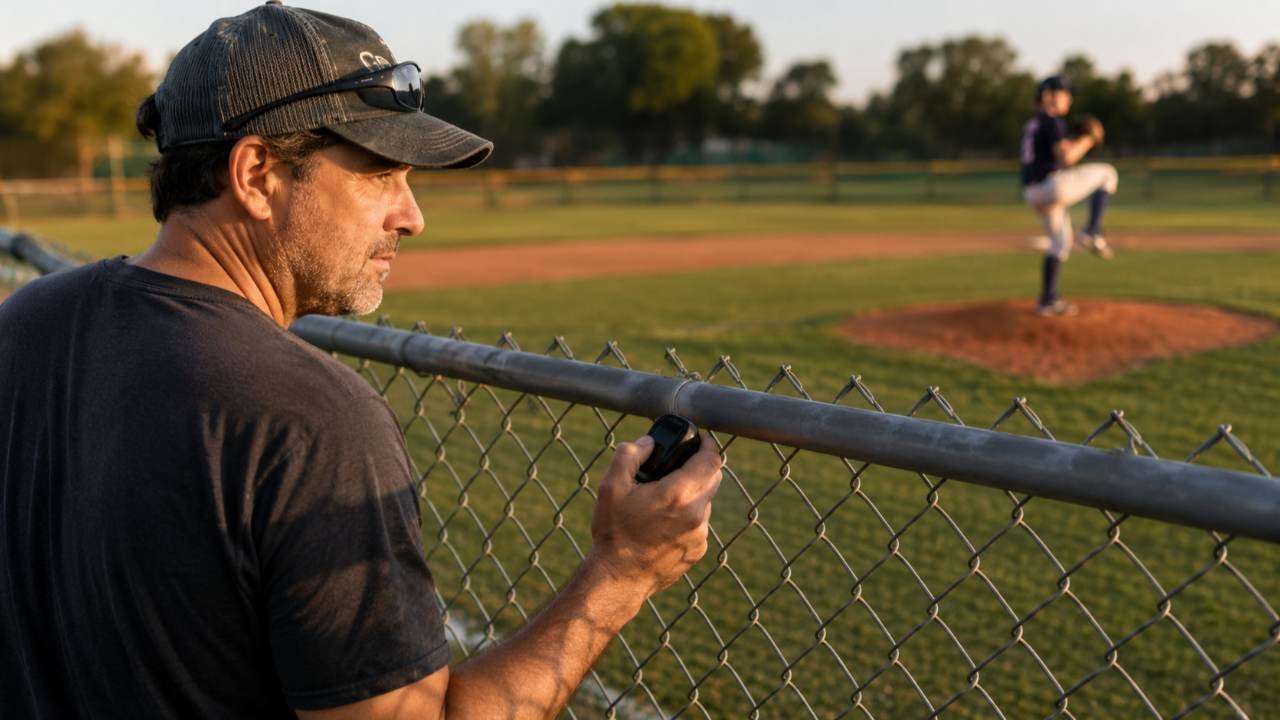
You've been tracking the pitch count all game. He's at 72 — under the limit. You know the rules. You're doing it right.
And yet something feels off. His velocity dropped in the fifth inning. He shook out his arm between hitters. The coach asked if he was good and he said yes, but the way he said it didn't fully land.
This is the gap pitch counts leave open. They were designed to solve one problem: too many pitches in a single outing. They weren't designed to tell you whether your pitcher's arm is actually ready — for this game, for this week, for this stretch of the schedule.
Here's what pitch counts measure, what they miss, and what parents can track alongside the numbers to get a more accurate read on where their pitcher actually stands.
What pitch counts actually measure
Pitch counts measure one thing: the number of competitive pitches thrown in a single outing. That's it.
They were introduced as a harm-reduction tool — a floor beneath which the most dangerous single-game overload scenarios couldn't happen. A pitcher throwing 150 pitches at age 12 is a documented injury risk. Pitch count rules largely solved that problem at the organized league level.
What they don't measure:
- How many throws the pitcher made in practice before the game
- Whether he played shortstop in the JV game yesterday and threw 40 balls from the hole
- How many innings he's pitched in the last 6 weeks across two teams
- Whether his arm has actually recovered from the last outing
- Whether he's throwing through discomfort he hasn't disclosed
- What his arm feels like at pitch 60 versus pitch 30
Pitch count limits tell you when to pull a pitcher if he's been fine all game. They don't tell you whether he was fine to start.
What the research says pitch counts miss
The American Sports Medicine Institute (ASMI) has published extensive research on youth pitching injuries. The findings consistently point to factors that pitch count rules were never designed to capture.
The three factors most predictive of injury risk, independent of per-game pitch limits:
- Total innings pitched per year. Pitching more than 100 innings in a single calendar year is associated with a 3.5x higher likelihood of requiring surgery at some point in a pitcher's career. Per-game limits do nothing to reduce this if a pitcher simply plays on more teams or pitches deep into multiple seasons.
- Pitching while fatigued. In one ASMI survey, youth pitchers who reported pitching through arm fatigue were 36 times more likely to have required surgery than those who did not. Thirty-six times. Pitch counts don't measure whether a pitcher is fatigued — they measure whether he's exceeded a volume threshold.
- Pitching on multiple teams simultaneously. A pitcher who plays for a school team, a travel team, and a recreational league can stay within per-game limits on all three rosters while accumulating an annual workload that exceeds what the research considers safe. The limits are per-game. The injury risk is cumulative.
Pitch count rules address scenario one (per-game volume) and don't address scenarios two and three at all. That's not a design flaw — it's a scope limitation. The rules were never meant to be a complete arm-health system. Many parents treat them as one anyway.
Why a pitcher can be "within limits" and still be at risk
Pitch count compliance is binary — a pitcher either exceeded the limit or didn't. Arm health is not binary. It's a spectrum.
A pitcher who threw 65 pitches last Saturday, did a bullpen Tuesday, played catcher at practice Thursday, and started again this Saturday has accumulated a week of throwing that no single-game pitch count captures. Each individual session was within limits. The cumulative workload tells a different story.
The same is true for fatigue. A pitcher at 50 pitches in August after a full travel ball summer isn't in the same physiological state as a pitcher at 50 pitches in March at the start of the season. The pitch count is identical. The arm's capacity to absorb it is not.
This is what parents describe when they say, "We're following all the rules — so why does it still feel off?" They're following the rules correctly. The rules just aren't designed to answer the question they're actually asking.
The 6 arm signals pitch counts can't catch
Youth pitchers send signals before they send pain reports. Most of those signals don't show up in a stat line or a pitch count. They show up in behavior — in how the arm looks, how the pitcher carries himself, and what changes in the week around a tough outing.
These are the six patterns that matter most:
- The Elbow Rub. Reaching back to touch or rub the inner elbow between pitches or at-bats. This isn't a tick — it's a response to discomfort the pitcher may not consciously recognize as pain yet.
- The Shoulder Shrug. Rotating or shrugging the throwing shoulder between throws, especially in the later innings of a start. The arm is trying to reset something that isn't resetting on its own.
- The Stiff Turn. Trouble turning freely to look at a runner at second base — or a first-morning reach for a high shelf that produces a grimace. Post-outing stiffness that lingers past 24–36 hours is a signal, not normal soreness.
- The Sudden Velocity Dip. A drop of 2–5 mph that persists across multiple outings — not a single bad game, but a pattern. This is one of the most consistent early indicators of arm fatigue or overload. Scouts see it. Radar guns confirm it. Parents tracking over multiple weeks can notice it too.
- The "I'm Fine" Mask. The pitcher who deflects every arm question, pivots to "I just need to warm up," or answers so quickly it doesn't register as a real answer. This isn't dishonesty — it's identity protection. Youth pitchers often believe that admitting arm soreness makes them unavailable, which makes them less valuable. They manage through discomfort rather than disclose it.
- The Confidence Spiral. Mechanical breakdown — walking batters he normally handles, short-arming the ball, pulling off at release — that isn't caused by mental pressure alone. When mechanics suddenly fall apart without an obvious explanation, fatigue and compensation are often the underlying driver.
None of these appear in a pitch count. All of them appear in the arm you're watching, if you know what to look for across multiple outings rather than evaluating each game independently.
What "cleared to throw" actually means — and what it doesn't
"Cleared to throw" is a medical status. It means a physician has determined that the arm has healed to a point where throwing activity can resume. It answers one question: Has the injury resolved enough to begin throwing?
It doesn't answer: How much can he throw? Is his arm fatigue reset? Has his movement pattern changed during the rest period? Is he actually ready for a competitive workload, or just ready to play catch?
Parents of pitchers returning from Little League elbow or shoulder soreness often receive medical clearance and return their pitcher to a normal schedule — only to see the same symptoms resurface within a few weeks. The clearance was accurate. The return ramp wasn't calibrated to what the arm could actually handle.
Cleared to throw means the injury chapter closed. It doesn't mean the readiness chapter opened automatically. Those are two separate conversations, and pitch counts don't help with the second one either.
What to track alongside pitch counts
The goal isn't to replace pitch count tracking — it's to add signal layers that pitch counts can't provide. Three things parents can track without medical training:
1. Weekly throwing volume, not just game pitches. A rough count of all significant throwing across the week — bullpen sessions, infield practice, long toss, pre-game warm-up. This doesn't need to be exact. You're looking for weeks where the total volume is unusually high relative to the recovery window available before the next game.
2. Recovery markers 24–48 hours after a start. How stiff is the arm the morning after? Does warmth and light movement clear it within an hour, or is the stiffness still there at practice the next day? Arm soreness that clears within 24 hours is different from arm soreness that's present at the next practice. The second one is a signal worth noting.
3. The six behavioral signals across multiple outings. You're not evaluating any one game in isolation. You're looking for patterns — the Elbow Rub that starts showing up in the 4th inning, the velocity that's been consistently 3–4 mph lower than March. Patterns require multiple observations to see. A pitch count chart per game doesn't build that picture. Week-to-week signal tracking does.
Want a read on where your pitcher's arm stands right now?
The 2-Minute Arm State Check asks 8 questions about what you've been seeing — and tells you whether it signals Green (expected recovery), Yellow (worth watching), or Red (act now). No pitch count required.
Take the Check →Frequently asked questions
Do pitch counts prevent arm injuries in youth pitchers?
Pitch counts reduce the risk of severe single-game overload, which was their original purpose. But ASMI research consistently shows that total annual innings, pitching while fatigued, and pitching on multiple teams simultaneously are more predictive of injury than per-game pitch counts. A pitcher can stay within all per-game limits and still accumulate a cumulative workload that exceeds what their arm can safely handle over a season.
What causes arm fatigue in youth pitchers if it's not pitch count?
Arm fatigue in youth pitchers accumulates across all throwing — not just competitive pitches. A pitcher who throws 50 competitive pitches, then takes 40 throws from shortstop at practice, then does a bullpen mid-week has a real arm workload that a per-game pitch count doesn't capture. Fatigue also builds over a season. A pitcher's arm in August after a full travel ball summer has absorbed significantly more cumulative stress than the same pitcher at 50 pitches in March — even if the single-game number looks identical.
What are the signs of arm fatigue in a youth pitcher?
The most visible signs parents can track: a sustained velocity drop of 2–5 mph across multiple outings (not a single bad game), mechanical changes that appear without an obvious coaching cause, warmup that takes noticeably longer than usual, post-outing stiffness that persists past 24–36 hours, and behavioral signals like rubbing the inner elbow between pitches or deflecting arm questions consistently. Any one of these in isolation may mean nothing. A pattern of them across multiple weeks is a signal worth taking seriously.
Should I trust pitch counts or should I ignore them?
Neither. Pitch counts provide a useful per-game floor — they prevent the most extreme single-outing overload scenarios and they're a reasonable starting point for arm-health conversations with coaches. But they were designed to solve one specific problem, not to be a complete arm-health monitoring system. The most useful approach is to track pitch counts and the behavioral, recovery, and workload signals that pitch counts can't measure — so you're working with a fuller picture of what your pitcher's arm is actually handling.
When should I take my youth pitcher to a doctor for arm concerns?
Pain that occurs during throwing — not just soreness the morning after — is a clinical threshold worth evaluating. So is pain that's localized to the inner elbow, inner shoulder, or back of the shoulder, rather than general muscle fatigue. A sustained velocity drop, mechanics that have clearly changed, or a pitcher who is consistently guarding the arm are also signals worth a conversation with a sports medicine physician. When in doubt, evaluate early — the injury picture at an early stage is almost always more manageable than the same injury after another four weeks of competition. Inner-elbow pain during throwing, specifically, is also the earliest observable signal associated with UCL stress — for parents who want to understand what that pattern means before it becomes a Tommy John conversation, the guide on Tommy John warning signs parents can read from the sideline covers what the research says and what to watch for.
VeloRESET provides educational information for parents of youth baseball pitchers. This content is not a substitute for evaluation, diagnosis, or treatment by a qualified medical professional. If your pitcher is experiencing arm pain during throwing, consult a sports medicine physician.