
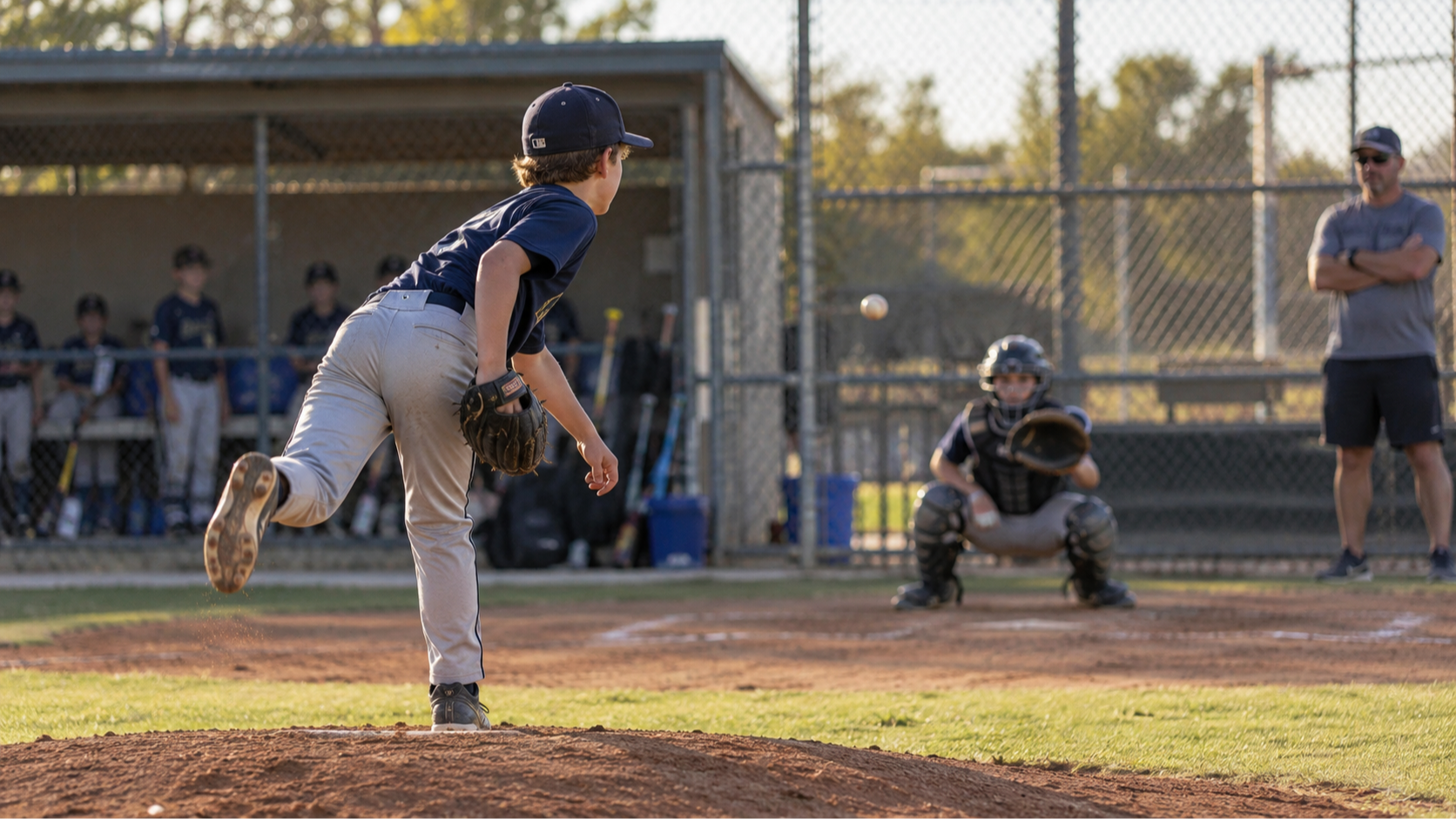
The bullpen looked fine. What you don't see is what it adds to the week.
A practical guide to youth pitcher bullpen frequency — how often is appropriate, how to read the warning signs, and how to structure the throwing week.
By Joey Myers · VeloRESET · Youth pitcher arm care for parents
Most parents track game pitches carefully. They follow the pitch count guidelines, account for rest days, and feel reasonably sure they're managing the arm's workload. But youth pitcher bullpen frequency rarely enters that same conversation. A bullpen isn't practice that's separate from arm stress — it's part of the week's total. How often a youth pitcher throws bullpens, and how those sessions layer onto game pitching and regular practice throwing, determines whether the arm is accumulating more than it can recover from. This page covers what actually matters when evaluating bullpen frequency — and what the arm is doing in the 24 to 72 hours after each session.
Not sure where the arm stands right now? Take the Arm State Read →
What counts as a bullpen for a youth pitcher's arm workload?
A bullpen counts as throwing workload — not as separate practice that sits outside the arm's weekly total.
When parents think of a bullpen, they often picture light work: rhythm, touch, mechanical feel — not a real arm stress event. However, from the arm's perspective, a bullpen involves high-effort throws, mechanical repetition under load, and progressive fatigue accumulation — especially as the session builds. The arm doesn't distinguish between a bullpen throw and a game pitch at the same effort level. Tissue responds to effort and repetition, not context.
Whether the session is 20 pitches or 45, it registers as throwing stress. Additionally, that stress adds directly to whatever else the arm is already carrying from games and practice throwing during the same week. Understanding that reality changes how to evaluate whether another bullpen fits into a given week.
How often should youth pitchers throw bullpens during the season?
For most youth pitchers who are also pitching in games, one bullpen session per week is the practical ceiling during the season — and fewer is appropriate when game workload is already high.
The research helps explain the reasoning. ASMI's youth baseball research and supporting studies tracking muscle damage markers in pitchers found that muscle cell breakdown from throwing peaks at approximately 72 hours post-session — not the following morning. That finding matters for youth pitcher bullpen frequency because it means the arm from a Saturday game isn't fully recovered by Monday.
Research finding: Muscle cell breakdown from throwing peaks at approximately 72 hours post-session — not the next morning. A bullpen thrown within 48 hours of a game means the arm starts that session already mid-recovery.
For pitchers ages 9–12, one bullpen session per week is the practical upper limit when games are also in the schedule. That session should sit at least two full recovery days after a game appearance and at least two days before the next one. For pitchers ages 13–16, one or two sessions per week may be workable during lighter game weeks — but only when each session has adequate spacing. During high-volume tournament weekends, cutting the bullpen entirely and prioritizing recovery is often the better call. Furthermore, a competitive bullpen at full effort creates a stress profile comparable to a game outing of the same pitch count. Treating both identically understates how much work the arm is actually doing that week.
Why does the arm sometimes feel worse the day after a bullpen?
Throwing stress from a bullpen often peaks 24 to 72 hours after the session — not during it or immediately after.
This delayed response catches many families off guard. The bullpen finishes and the arm feels fine. The next morning, it's stiffer or heavier than expected. That's inflammation responding on its own timeline — not a bullpen-specific defect. However, when delayed arm heaviness becomes the consistent pattern — when the arm reports every morning after a bullpen — that's a signal the frequency or volume is higher than what the arm is currently recovering from between sessions.
For more on what fatigue after a bullpen actually looks like and what to do about it, that distinction matters before scheduling the next session. Understanding the timing of throwing-related fatigue is one of the most practical pieces of information a parent can have when evaluating a weekly throwing schedule.
How does bullpen frequency stack with game pitching for youth pitchers?
Bullpens, game pitches, and practice throwing all draw from the same weekly recovery budget. They don't operate on separate accounts.
A common in-season pattern looks like this: a Saturday game at 60 pitches, a Tuesday bullpen, a Thursday practice throwing session, then another Saturday game. That structure leaves roughly 36 to 48 hours of recovery between each high-effort throwing event. For many youth pitchers — particularly those going through active growth phases — that's not enough time for full recovery before the next mound appearance. The arm carries fatigue from one session into the next, and the accumulation builds quietly until something signals it's too much.
When evaluating safe bullpen frequency for a given week, the more useful question isn't "how many bullpens this week?" It's: what is the total throwing stress this week, and does the arm have adequate time to recover before the next high-effort session? That reframe changes how a weekly schedule looks on paper.
It's also worth noting that official pitch count guidelines — including USA Baseball's Pitch Smart guidelines — track only game pitches. Bullpens are invisible in those limits. A pitcher can be fully within league guidelines while carrying a workload their arm isn't recovering from week to week.
Does the intensity of the bullpen matter — or just the pitch count?
Yes — a max-effort bullpen session creates significantly more arm stress than a light touch-and-feel session at the same pitch count.
There are two meaningfully different types of bullpen sessions. A light bullpen is thrown at roughly 55 to 70 percent effort, focused on rhythm, timing, and mechanical feel. These sessions are lower-stress, recover faster, and are appropriate more frequently during high-volume game periods. A competitive bullpen, by contrast, is thrown at 85 to 100 percent effort — typically with a catcher, simulating game conditions — and creates a stress profile comparable to a game outing of equivalent pitch count.
Therefore, a competitive 40-pitch bullpen should be treated similarly to a 40-pitch game appearance in terms of rest and recovery planning. During high game-volume periods, switching from competitive to lighter bullpen sessions is one practical way to keep the pitcher mechanically sharp without adding workload the arm can't absorb in time. Most families don't make this distinction — and treating all bullpens the same consistently underestimates total arm stress.
"Javier went through a big workload spike — suddenly going from not playing varsity to playing every day on JV — and his tricep near his throwing elbow started acting up. What I appreciate is that we're not just waiting and hoping. We know what we're looking at."— Richard, Javier's dad · sophomore catcher
Not sure if the current throwing schedule is too much for the arm?
The Arm State Read helps you get a clearer picture of where the arm actually stands — before you schedule the next bullpen.
Take the Arm State Read →What does a balanced throwing week look like for a youth pitcher?
A well-structured throwing week pairs each high-effort mound session with at least two full recovery days before the next one.
In practice during a typical in-season week: if the pitcher throws in a Saturday game, the earliest a competitive bullpen should happen is Tuesday. If the next game is Thursday, a mid-week bullpen means the arm goes into Thursday carrying unresolved fatigue from two back-to-back efforts in close proximity — 48 hours or less apart. For most youth pitchers, two to three high-effort throwing sessions within a seven-day window — game, bullpen, game — is close to the upper workload limit. More than that, and the arm begins accumulating fatigue into each new session before the previous one has cleared.
Knowing when to give the arm a full rest — not just a lighter week, but a genuine rest period — is part of managing bullpen frequency across a full season, not just week to week. Short-term scheduling decisions compound into long-term patterns the arm either absorbs or doesn't.
How do you know when bullpen frequency has become too high for a youth pitcher?
The most reliable signals are arm heaviness that persists after sessions, a measurable velocity drop from the pitcher's established baseline, or changes in how the arm feels at the beginning of a session rather than only at the end.
When a pitcher's arm feels heavier going into a bullpen than it did three weeks ago — that's a workload signal. When early-session command looks like it used to look deep in games — that's compensation. When distinguishing arm soreness vs. arm pain starts getting harder to call — that's worth taking seriously. These signals don't necessarily point to injury. However, they do indicate the current frequency is higher than what recovery currently allows.
A heavy arm that doesn't bounce back between sessions is the arm's clearest communication about its actual state. The question is whether the schedule leaves enough space to hear it before the next bullpen goes on the calendar.
Frequently Asked Questions
How often should a youth pitcher throw a bullpen during the season?
During the season, most youth pitchers handle one bullpen session per week safely when they're also throwing in games. That session should sit at least two full recovery days after the previous game and at least two days before the next one. During high-volume tournament weekends with multiple games, skipping the in-week bullpen entirely and prioritizing recovery is often the more appropriate choice. Youth pitcher bullpen frequency should decrease as game workload increases — not stay fixed regardless of what else the week holds.
Does a bullpen count toward a youth pitcher's official pitch count?
Most official youth league guidelines — including USA Baseball's Pitch Smart guidelines — track only pitches thrown in games. Competitive bullpen sessions at full effort are not included in those limits. However, a competitive bullpen at the same pitch count as a game outing adds comparable arm stress. Tracking game pitches while ignoring bullpen throws understates the arm's total weekly workload and can lead to overuse even when a pitcher appears to be within official limits.
How long should a youth pitcher rest after a bullpen?
After a competitive bullpen at full effort, most youth pitchers need at least two full recovery days before the next high-effort throwing session — whether that's a game or another bullpen. After a lighter bullpen session at reduced intensity, one to two days before low-intensity throwing is typical. Research tracking muscle damage markers in pitchers shows that breakdown from throwing peaks at approximately 72 hours post-session. That's why scheduling a mound appearance within 48 hours of a previous one creates compounding stress rather than fresh independent effort.
What's the difference between a light bullpen and a competitive bullpen for youth pitchers?
A light bullpen is thrown at roughly 55 to 70 percent effort, focused on rhythm, timing, and mechanical feel. It adds less arm stress and allows faster recovery. A competitive bullpen is thrown at 85 to 100 percent effort — typically with a catcher, simulating game conditions — and creates a stress profile similar to a game outing of equivalent pitch count. Youth pitchers can throw light bullpens more frequently than competitive ones during high game-volume periods without the same recovery cost. Making this distinction is one of the most underused tools for managing weekly throwing load.
Can a youth pitcher throw a bullpen and pitch in a game in the same week?
Yes — a bullpen and a game in the same week is manageable when they're appropriately spaced. A Saturday game followed by a Tuesday or Wednesday bullpen, with the next game the following weekend, typically provides enough separation. Problems arise when the bullpen is too close to a game on either side — within one or two days — because the arm has not fully recovered from one high-effort session before the next one begins. The spacing matters as much as the total number of sessions in the week.
How do I know if my son is throwing too many bullpens?
The most consistent signals are arm heaviness that lingers into the day after a bullpen, a velocity drop of 2 to 4 miles per hour from the pitcher's established baseline, or arm stiffness that persists into the early innings of the next outing. If the pitcher mentions the arm feels heavier going into sessions than it used to — or if command under low fatigue early in games has declined — those are workload signals worth taking seriously. They don't necessarily mean something is wrong, but they do suggest the current bullpen frequency is higher than recovery currently allows.
Should bullpen frequency change during a youth pitcher's growth spurt?
Yes. During active growth spurts, bones, tendons, and soft tissue are all changing simultaneously. A youth pitcher's tolerance for repeated high-effort throwing typically decreases during these periods — even when overall conditioning stays the same. Reducing competitive bullpen frequency and shifting toward lighter sessions during a known growth spurt is a reasonable adjustment. Growth spurt timing varies considerably between athletes, which is why age-based guidelines are a useful starting point but not a hard ceiling for every individual situation.
Want a clearer framework for managing your pitcher's throwing week?
Chapter 1 of the free book covers how to think about total weekly throwing load — games, bullpens, and practice throwing together — in a structure any parent can use.