The Summer Arm Overload Problem: Why Travel Ball + School Ball + Lessons Is a Hidden Risk
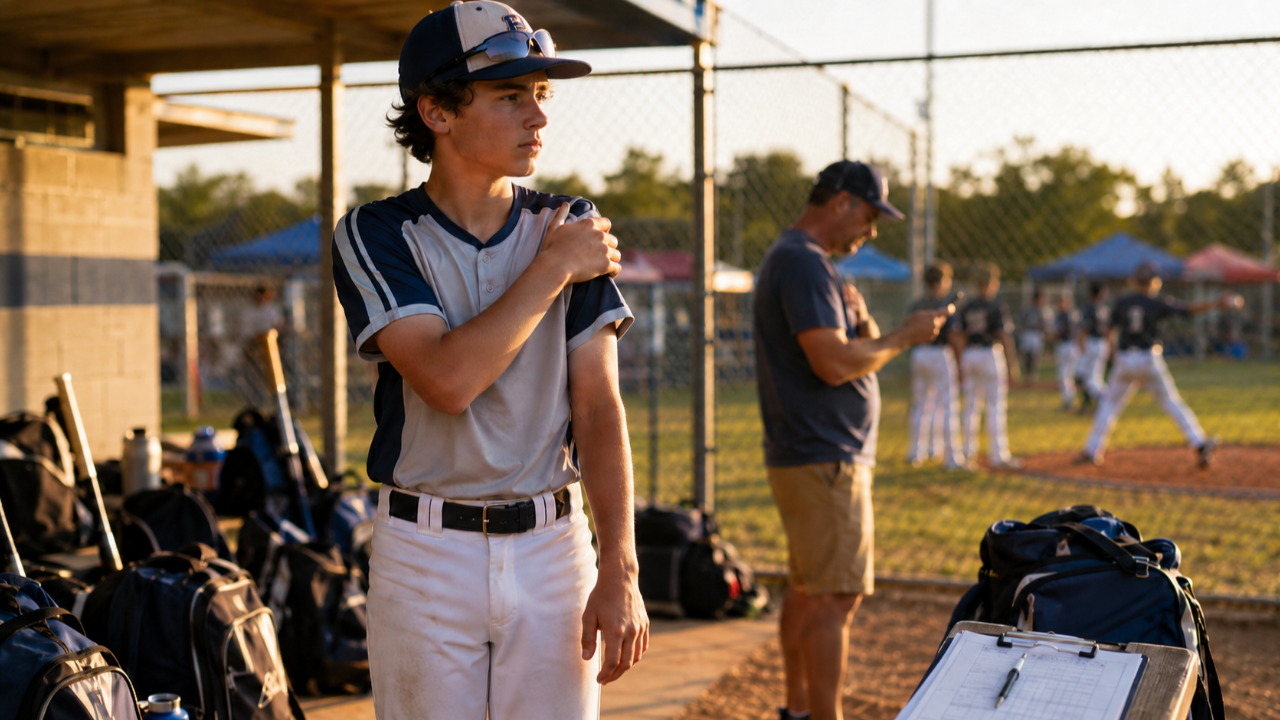
The Summer Arm Overload Problem: Why Travel Ball + School Ball + Lessons Is a Hidden Risk
Summer is the season when youth pitcher arm problems escalate — not because any single program is reckless, but because every program is operating independently while the arm absorbs all of them at once.
Travel ball has its own schedule. School ball has its own pitch count rules. The private pitching coach has his own throwing program. Each individual source may look completely reasonable. The cumulative demand on the arm is what nobody is tracking.
How Workload Stacking Creates Youth Pitcher Arm Overuse
Workload stacking happens when a youth pitcher is participating in multiple throwing programs simultaneously, with no single adult in the picture tracking the total. Each coach sees the pitcher in their context. None of them sees the full week.
A typical summer week might look like this: travel ball tournament on Saturday and Sunday — 70 pitches Saturday, 40 pitches Sunday. Private lesson on Tuesday — 50 throws at high intensity including bullpen work. School ball practice on Wednesday — pitchers run poles, throw bullpens, take fielding reps. Another travel ball game Friday — 65 pitches.
By the guidelines of any individual program, nothing looks excessive. The travel ball tournament was within pitch count limits. The lesson was a normal session. School ball practice is standard. But the arm threw at high intensity on five of seven days that week with no meaningful recovery window.
That arm is being overused — even though every individual program would consider it within normal parameters. The load compounds further for pitchers who also catch: pitcher-catchers at the travel ball level often receive a full game behind the plate on days they’re not pitching, adding rotational shoulder stress that doesn’t appear in any pitch count tracker.
Why Summer Is the Highest-Risk Window for Youth Pitcher Arms
During the school year, the calendar naturally creates some recovery structure. School days limit afternoon practice hours. Weather interrupts. Schedules are more predictable.
Summer removes those constraints. Travel ball tournaments run back-to-back weekends from June through August. Showcase events add additional high-intensity outings. Parents — wanting to maximize development during the time available — schedule lessons in between. Some pitchers also pick up summer league games to stay sharp between tournaments.
The result is a three-to-four month window of near-continuous throwing demand with minimal built-in recovery. For an arm that's still developing — particularly in the 12–16 age range when growth plates are active — that's the highest-risk combination of factors the season produces.
The Signals That Summer Overload Is Building
Summer arm overload rarely announces itself as a single acute injury. It builds gradually through a pattern of signals that parents can track week to week:
Recovery windows are extending. The arm that used to feel ready 24 hours after a game is now taking 48–72 hours. For pitchers who are naturally very flexible, this extension often happens earlier in the summer and more noticeably — because the active stabilizers are working harder per pitch than the pitch count suggests, and they deplete faster. The guide to hypermobility in youth pitchers covers why this population accumulates summer load differently and what to watch for. The warmup that used to take 10 minutes is now taking 20. The arm is working harder to reset between sessions because the recovery debt is accumulating. That extending recovery window is often what parents describe as dead arm — the arm feeling flat and heavy by Sunday of a tournament weekend when it felt fine on Saturday. Knowing whether that's normal fatigue or a signal worth paying attention to changes what the next week looks like.
Soreness is changing character. The diffuse fatigue soreness of a normal throwing week is being replaced by something more localized — a specific point in the elbow, a particular spot in the shoulder, a tightness that doesn't resolve the way it used to.
Performance is inconsistent in a specific pattern. The pitcher who is strong early in a tournament and noticeably weaker by Sunday is showing arm fatigue accumulation across days. The pitcher who starts games well and loses command and velocity as the game progresses is showing within-outing fatigue that's getting worse as the summer continues.
The "I'm fine" answer is getting quicker. As the arm gets more tired, young pitchers often become more automatic in their reassurances. The fatigue is normal to them now — they've calibrated down to it — and they've learned that saying otherwise changes things.
What Parents Can Do About Summer Arm Overload
Track the total, not just the program. At the start of each week, add up all the throwing your pitcher is expected to do — games, lessons, practice, bullpens, long toss, fielding work. The total weekly throwing demand is what matters, not any individual session in isolation.
Build at least one genuine off-arm day per week. Not a rest day with light tossing. A day where the arm is not asked to throw at all. One built-in recovery day per week is the minimum effective rest structure for a pitcher in a high-demand summer schedule.
Protect one full recovery weekend per month. If the summer schedule allows, building one weekend per month with no competitive throwing — no tournament, no showcase, no lesson — gives the arm a genuine reset window before the next stretch of demand. For the weekends where competition is happening, the decisions made in the days before and between games matter more than most parents realize — see the guide on youth pitcher arm care before a tournament for what the pre-tournament week and the weekend itself should look like.
Run a weekly arm state check. Before each throwing week begins, take five minutes to assess where the arm actually stands. Not based on how the last game went — based on how the arm is recovering, what it felt like during warmups, and what the pitcher is communicating (or not). A Green / Yellow / Red read at the start of each week gives you a clear decision framework for what to add, maintain, or reduce.
Frequently Asked Questions
How many travel ball tournaments is too many for a youth pitcher in one summer?
There is no single number that applies to every pitcher — the right limit depends on recovery. If the arm is arriving at each tournament genuinely fresh, frequency is manageable. If recovery windows are extending or soreness is changing character between events, the schedule is too full regardless of the pitch count at each tournament. Track how the arm recovers between outings, not just how many outings are on the calendar.
Should my youth pitcher take private pitching lessons during the travel ball season?
Lessons during the season can help, but only when the throwing volume is counted in the total weekly load — not treated as a separate activity. A high-intensity lesson two days before a tournament effectively doubles the arm's demand that week. Timing and intensity matter as much as the lesson itself. If the lesson falls within a recovery window, it adds stress the arm hasn't finished absorbing yet.
What is a safe number of pitches per week for a youth pitcher?
USA Baseball and ASMI publish weekly pitch limits that vary by age — for example, approximately 75 pitches per week for ages 9–10, with higher limits for older pitchers. However, these pitch count guidelines across programs are designed for single-program participation. When a pitcher is throwing across travel ball, lessons, and school ball simultaneously, the total across all contexts is what should be compared to the guideline — not each program's count in isolation.
How do I know if my pitcher's arm soreness is from summer overload or a specific injury?
Summer overload fatigue typically feels diffuse and accumulates across the week — it responds to genuine rest and improves after a full off-arm day. A specific injury is more likely to be localized to a single point, present during or immediately after throwing, and not resolving with rest alone. When in doubt, reduce the throwing demand for a full week and evaluate whether symptoms improve. If they do not resolve with meaningful rest, seek evaluation from a sports medicine provider.
Not sure where your pitcher's arm stands heading into the next stretch?
The free 2-Minute Arm State Check gives you a Green, Yellow, or Red read — and a clear recommendation for the week ahead.
Take the Free Arm State CheckTakes about 2 minutes. No purchase required.