How to Talk to Your Son's Pitching Coach About Arm Concerns
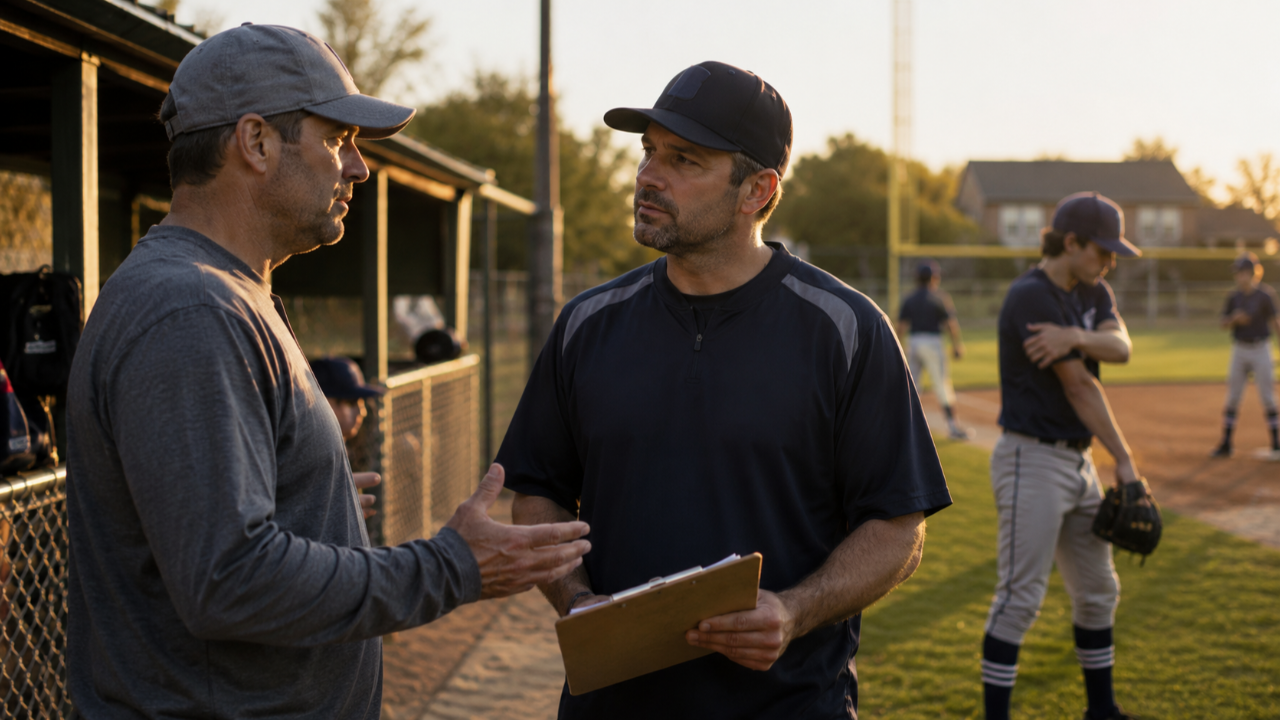
Raising arm concerns with your pitcher's coach is one of the hardest conversations in youth baseball. Not because coaches are unreasonable — most aren't — but because the conversation happens in a context loaded with competing pressures: playing time, roster decisions, team needs, and the unspoken worry that saying something will change how the coach sees your son.
The parents who navigate this well aren't the ones who stay quiet and hope for the best, or the ones who lead with emotion and demands. They're the ones who come to the conversation with specific, observable information rather than anxiety.
Why This Conversation Is Hard — And Why It Matters Anyway
Youth baseball culture sends a clear message: pitchers push through. Soreness is normal. Toughness is the expectation. Parents who raise arm concerns risk being labeled overprotective, or worse, getting their son labeled as injury-prone or soft.
Most parents know this, and most choose silence as the safer option. The arm keeps getting used. The signal gets ignored. The conversation that should have happened in May happens in July — after the arm has been telling you something for two months.
The goal isn't to make a confrontational case. It's to give the coach useful information and create a shared understanding of what the arm is telling you — so decisions about the next few weeks can be made with that information in the picture.
Before the Conversation: Know What You're Actually Seeing
The most common mistake parents make is approaching a coach with a feeling rather than an observation. "I'm worried about his arm" is a feeling. It invites dismissal — "he's fine, all pitchers deal with soreness."
Specific, observable information is different. Before you have the conversation, be clear about what you're actually seeing:
What signal is present? Not "he seems tired" — but: his warmup is taking significantly longer than it did two weeks ago. He's rubbing the inside of his elbow between innings. His velocity dropped noticeably from Saturday to Sunday at the tournament. He told me his arm felt heavy after the last game and it was still stiff two days later.
How long has it been present? Is this new from the last outing, or have you been tracking this pattern for two to three weeks?
What's the context? What's the total throwing load been like — games, practices, lessons — over the last two weeks?
Specific, timestamped observations are taken seriously. Generalized worry is easy to dismiss. If you're not yet sure what signals to name, The 6 Arm Signals Every Baseball Parent Misreads gives you the vocabulary before you walk into the conversation.
How to Open the Conversation
The framing that works best positions you as someone sharing information, not making a demand. The goal is to get the coach looking at the same data you're looking at — not to win an argument about whether your son should pitch.
A starting point that works: "Coach, I wanted to mention something I've been tracking with his arm over the last couple of weeks, and get your read on it."
That framing does three things. It signals that you have specific information, not just anxiety. It invites the coach's expertise rather than challenging it. And it makes clear you're asking for a conversation, not delivering a verdict.
Then share what you've observed — specifically, with timeframes. Follow with: "I don't know if this changes anything for you, but I wanted you to have the picture I'm seeing."
What to Ask For — and What Not To
The most useful thing to ask for is communication, not a decision. "Can we keep an eye on his pitch count and warmup quality this week and check in at the end of practice?" is a different ask than "I don't want him pitching Saturday."
The first opens a collaborative relationship. The second forces a yes or no that puts the coach in a defensive position.
What to avoid: ultimatums, comparisons to other pitchers, references to what you read online, or framing the concern as something the coach is doing wrong. The conversation goes better when you're both on the same side of the table looking at the same information — not across it.
What to ask for specifically: awareness of warmup quality before the next outing, a realistic pitch count for the week given recent workload, and an agreement to talk again if something changes. These are all reasonable asks that most coaches will respond to positively.
When the Coach Dismisses the Concern
Sometimes the conversation doesn't go well. The coach says the arm is fine, all pitchers deal with soreness, your son needs to compete. What then?
First: decide whether the signal you're seeing warrants a medical evaluation independent of the coaching conversation. If you're seeing Red-signal patterns — localized pain, sharp pain during throwing, mechanics that have significantly altered — that's a decision for a medical professional, not a coaching conversation.
Second: document what you shared and when. If the pattern continues and escalates, you'll want a clear record that you raised the concern.
Third: recognize that you control some of the variables. Private lesson volume, rest days, and post-game recovery choices are yours to manage. A coach who isn't incorporating your concern into game decisions doesn't prevent you from building in more recovery outside of games.
Frequently Asked Questions
How do I tell a coach my son's arm hurts without damaging his playing time?
Lead with specific observations, not a complaint. Coaches respond to "I've noticed his warmup is taking significantly longer and wanted to flag it" — not to "he says his arm hurts and I'm worried." Framing it as information-sharing rather than a demand keeps the coach collaborative. Specific observations invite problem-solving; general worry invites dismissal.
What if multiple coaches are involved — travel ball and school ball?
Both coaches need the same information, separately. Neither coach naturally tracks what the other program is doing, but the combined throwing load is what matters for youth pitcher arm health. Share the full picture with each coach — games, practices, and lessons from both programs — so each one can factor total workload into their decisions.
Should I pull my son from a game if his arm is bothering him?
It depends on the signal. A Red-signal arm — sharp pain, localized pain, or mechanics that have noticeably changed — warrants removing him from the game. A Yellow-signal arm — something feels off but not acutely wrong — warrants a conversation with the coach and close monitoring during the outing. A Green-signal arm with normal post-game soreness does not warrant removal. If you're unsure which category applies, see how to read arm signals during a heavy throwing schedule.
How do I know if my son's coach is being irresponsible with his arm?
Clear signs of irresponsible arm management include: pitching a player who has reported arm pain in the same outing, exceeding published pitch count guidelines without discussion, scheduling back-to-back high-intensity days with no rest built in, or dismissing documented concerns without any follow-up. If these patterns are consistent, a conversation with program leadership — not just the individual coach — may be warranted.
Walk into that conversation with a clear read — not just a gut feeling.
The free 2-Minute Arm State Check gives you a Green, Yellow, or Red result with specific observations you can share clearly.
Take the Free Arm State CheckTakes about 2 minutes. No purchase required.