What Pitch Counts Don't Tell You About Your Youth Pitcher's Arm
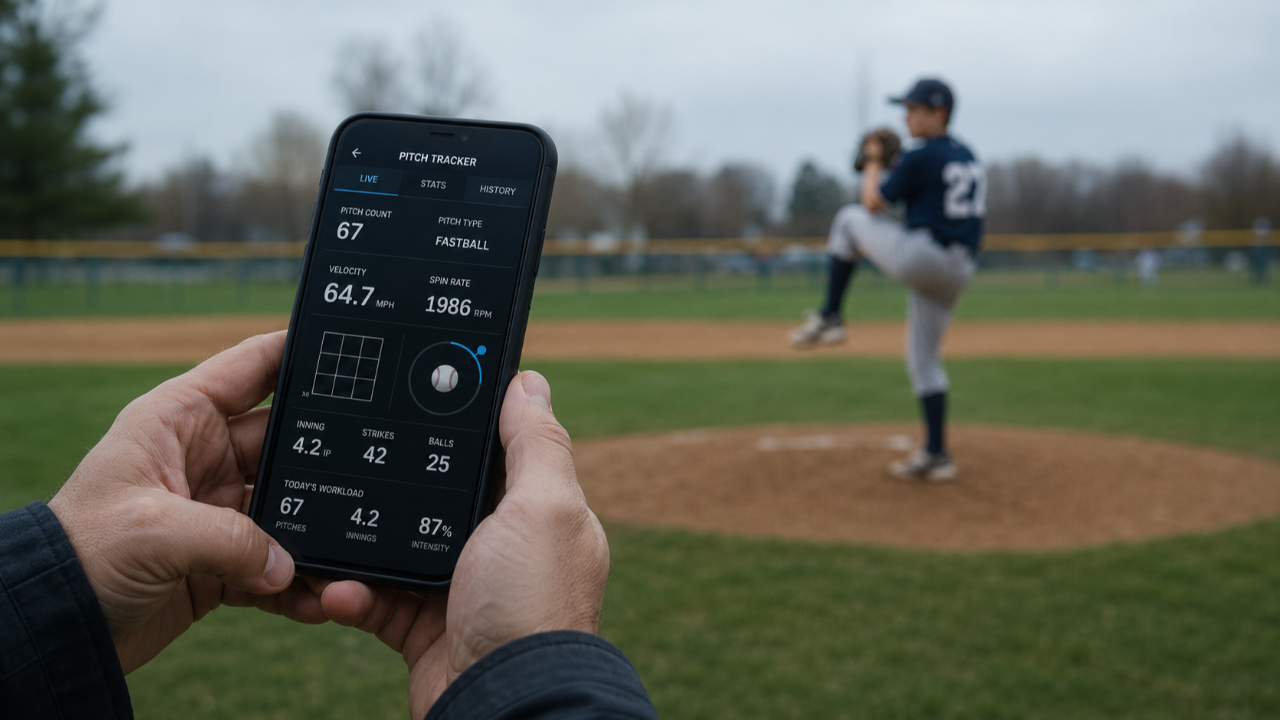
"We're following all the rules… so why does it still feel off?"
That's the question parents send us most often. And almost every time, the answer starts in the same place: pitch counts.
Pitch count limits are real. They matter. MLB's Pitch Smart guidelines — which cap 11–12 year olds at 85 pitches per game and require mandatory rest days based on pitch volume — represent decades of research on youth arm overuse. Following them is the right baseline. No argument there.
But here's what a pitch count cannot tell you: whether the arm that threw those pitches was ready to throw them, how hard each of those pitches was, what else the arm did that week besides pitch, or how well it's recovering right now.
Pitch counts measure volume. What they miss is everything else. And that gap — between what the number says and what the arm is actually experiencing — is where most youth pitcher arm pain lives.
This post walks through exactly what pitch counts measure, what they systematically can't see, and what a more complete picture of arm readiness actually looks like.
What Do Pitch Counts Actually Measure?
Pitch counts measure one thing: the number of throws made from the mound in a competitive outing.
That's it. A pitch count is a volume metric. It tracks how many throws were thrown. It says nothing about any of the following:
- How hard each throw was
- What the arm's state was before the first pitch
- How much throwing happened outside of the official game (warmups, bullpens, long toss, fielding)
- Whether the arm had recovered from the previous outing before this one started
- What else the pitcher did with the arm that week — batting practice, infield reps, catch in the backyard
Pitch count guidelines were designed to address a real problem: kids being left in games far too long, with no protection at all. They solved that problem. They were never designed to serve as a complete picture of arm health — and treating them as one creates a false sense of safety that the arm pays for later.
The Intensity Problem Pitch Counts Can't Solve
Not all pitches are equal. A max-effort fastball at 85% of a 14-year-old's top velocity stresses the arm very differently than a 70% long-toss throw of the same distance. The mechanics, the deceleration demand, the torque at the elbow — all of it changes with effort level.
Pitch count guidelines can't account for this because they weren't designed to. They count discrete throwing events. They don't weight for intensity.
This means a pitcher who throws 60 pitches in a high-stakes showcase game — all at maximum effort, adrenaline elevated, mechanics under pressure — is counted the same as a pitcher who throws 60 routine pitches in a midweek developmental game.
Research published through the American Sports Medicine Institute (ASMI) has consistently shown that medial elbow stress — the force vector that causes UCL damage over time — increases significantly with pitching velocity and effort level. A pitch count limit based on 60 pitches assumes a certain effort distribution. When that distribution skews hard, the limit doesn't adjust.
Parents notice this gap even if they can't name it. "His arm felt fine after the regular season games but got sore after the showcase." The counts were the same. The intensity wasn't.
Why Youth Pitcher Arm Pain Still Happens When Pitch Counts Look Fine
Pitch counts track the mound. They don't track the week.
A pitcher who throws 70 pitches in a Saturday game has a clean count. What pitch counts don't record:
- The 30-pitch bullpen session on Thursday to "get loose"
- The 25 throws of long toss on Tuesday with his travel team
- The batting practice he caught for his younger brother on Sunday
- The infield work where he made 15 strong throws from deep short
Add those up and the arm threw close to 140 times that week — not 70. The pitch count is clean. The cumulative stress is not.
This is the single most common reason parents who are doing everything right still see their pitcher develop arm soreness. They're tracking the visible number. The arm is absorbing the total number.
Research suggests it takes 4–6 days for full neuromuscular recovery after a high-pitch-count outing — and that's before accounting for cumulative in-season fatigue or multi-team throwing loads. When recovery is incomplete and the next session begins anyway, the deficit compounds. Over weeks, what started as Yellow becomes Red.
If your pitcher is pitching on multiple teams, this gap is especially important — because no single coach or count is tracking the full picture.
The Recovery State Pitch Counts Ignore
Pitch count guidelines build in mandatory rest days — typically 1 day for 1–20 pitches, up to 4 days for 66 or more. The logic is sound: more throwing requires more recovery before the next outing.
The problem is that recovery isn't linear, and it isn't the same for every arm.
A 13-year-old mid-growth-spurt arm recovers differently than a 16-year-old arm that has completed most of its skeletal development. An arm that has been carrying low-grade fatigue for three months of a long travel season recovers differently than one that's rested and fresh. An arm dealing with a growth plate that's under stress recovers differently than one that isn't — even if the pitcher reports no specific pain.
Pitch count rest requirements assume the arm arrives at the next session in a recoverable state. They don't have a mechanism for detecting whether it did. That's a gap the number can't close. For a full breakdown of why medical clearance and arm readiness are two different questions, see Cleared to Throw — But Is He Ready?
"I don't know if I'm being paranoid or if something's actually wrong" — that feeling usually shows up right here. The count looks fine. The required rest days were observed. And yet something in how the arm is moving, or something in how the pitcher is talking about it, doesn't sit right. That instinct is often correct. The count just isn't the right tool to verify it.
What Pitch Counts Can't Tell You: A Direct Summary
To be specific about the gaps, pitch counts cannot tell you:
- Arm readiness before the outing. Was the arm in a Green, Yellow, or Red state when the first pitch was thrown? The count starts at zero regardless.
- Intensity per throw. How hard was each pitch? High-effort throws carry more cumulative stress than the raw count reflects.
- Total weekly throwing volume. Bullpens, long toss, fielding, batting practice — none of it appears in the count.
- Recovery quality. Did the arm actually recover in the required rest window, or is it still carrying deficit from the previous outing?
- Cumulative in-season fatigue. A pitcher 10 weeks into a travel season with no off-weeks is not the same as a pitcher in week two. The count resets after every game. The body doesn't.
- Growth-related stress. Rapid growth creates vulnerability in the UCL, growth plates, and surrounding soft tissue that has nothing to do with pitch volume in any given game.
None of this is a criticism of pitch count guidelines. They do what they were designed to do. The problem is using a volume metric to answer a readiness question — and that's a different question entirely.
For a closer look at why the apps built around pitch count tracking still fall short, see why pitch count apps aren't enough — and for a direct comparison of what tracking tools miss versus what a real workload assessment looks like, see the full breakdown of pitch count apps vs real workload.
What Fills the Gap Pitch Counts Leave?
The gap pitch counts leave is a readiness gap. The question pitch counts can't answer is: Is this arm ready for what we're about to ask of it?
Answering that question requires looking at signals the arm is actually giving right now — not just the volume of what was thrown last weekend. It means noticing things like:
- Whether the arm is arriving at sessions with normal looseness or needing extra time to feel right
- Whether velocity is holding consistent or showing a pattern of drop from outing to outing
- Whether the pitcher is protecting the arm in ways he may not even realize — different grip pressure, shorter arm path, less conviction on hard pitches
- Whether soreness is resolving between sessions or accumulating
- Whether the arm is in a growth phase that changes what stress levels mean
This is what the Green / Yellow / Red Readiness Spectrum is built to do. Green means the arm is arriving fresh and handling demand normally. Yellow means one or more signals are present — not a shutdown signal, but a "pay attention and reduce demand this week" signal. Red means multiple signals are converging, or a single signal has been escalating, and the arm needs space before more stress is added.
The VeloRESET Decision Loop — Notice what's changing, Understand what it means, Adjust the workload, Support recovery — is how you move through that read in a structured way that doesn't require guessing.
You can explore all the decision tools in one place at the Arm Care Decision Hub.
Frequently Asked Questions
Do pitch count limits actually prevent youth pitcher arm injuries?
Pitch count limits reduce the risk of overuse injuries caused by volume, but they don't eliminate arm injuries — because volume is only one factor. Research consistently shows that intensity, cumulative weekly throwing load, recovery quality, and growth-related vulnerability all contribute to arm stress independently of pitch count. Following pitch count guidelines is a necessary baseline, not a complete protection plan.
Why does my youth pitcher have arm soreness when we stayed within pitch count limits?
Pitch counts only measure throws from the mound in official games. They don't capture bullpen sessions, long toss, fielding throws, or throwing in other contexts that week. They also don't measure how ready the arm was before the outing or how well it's recovering after. A pitcher can have a clean count and still carry significant cumulative stress — particularly deep in a long travel season or when pitching on multiple teams.
What's the difference between pitch count rest requirements and actual arm recovery?
Rest requirements built into pitch count guidelines assume the arm will recover within a defined window — typically 1–4 days depending on pitch volume. Actual arm recovery depends on factors those guidelines can't account for: in-season cumulative fatigue, growth phase, total weekly throwing volume across all contexts, and individual variation between arms. The required rest day is a minimum floor, not a guarantee of readiness.
How many pitches is too many for a youth pitcher in a week?
Pitch count guidelines cap single-game outings by age — MLB's Pitch Smart guidelines set the cap at 85 pitches per game for 11–12 year olds, 95 for 13–14, and 105 for 15–16. But they don't address total weekly volume across all throwing contexts. Research suggests full neuromuscular recovery after a high-pitch-count outing takes 4–6 days — meaning back-to-back high-demand sessions within that window are adding stress before the arm has cleared the previous load.
What should I track instead of — or in addition to — pitch counts?
In addition to pitch counts, tracking total weekly throwing volume (including bullpens, long toss, and fielding), arm readiness signals before each outing, and recovery patterns between sessions gives a much more complete picture. Specifically: Is velocity holding consistent? Is the arm taking longer to feel loose? Is the pitcher mentioning soreness that's persisting rather than resolving? Those signals — not the count alone — tell you whether the arm is in a Green, Yellow, or Red state heading into the next week.
What's the pitch count missing about your pitcher's arm right now?
The VeloRESET Arm State Read gives you a personalized Green / Yellow / Red read on your pitcher's arm — what pitch counts can't tell you, answered in 5 minutes.
Get the Arm State Read — $27One-time · Instant access · 30-day Calm Parent Guarantee