Is My Youth Pitcher's Arm Sore or Hurt? A Parent's Weekly Decision Guide
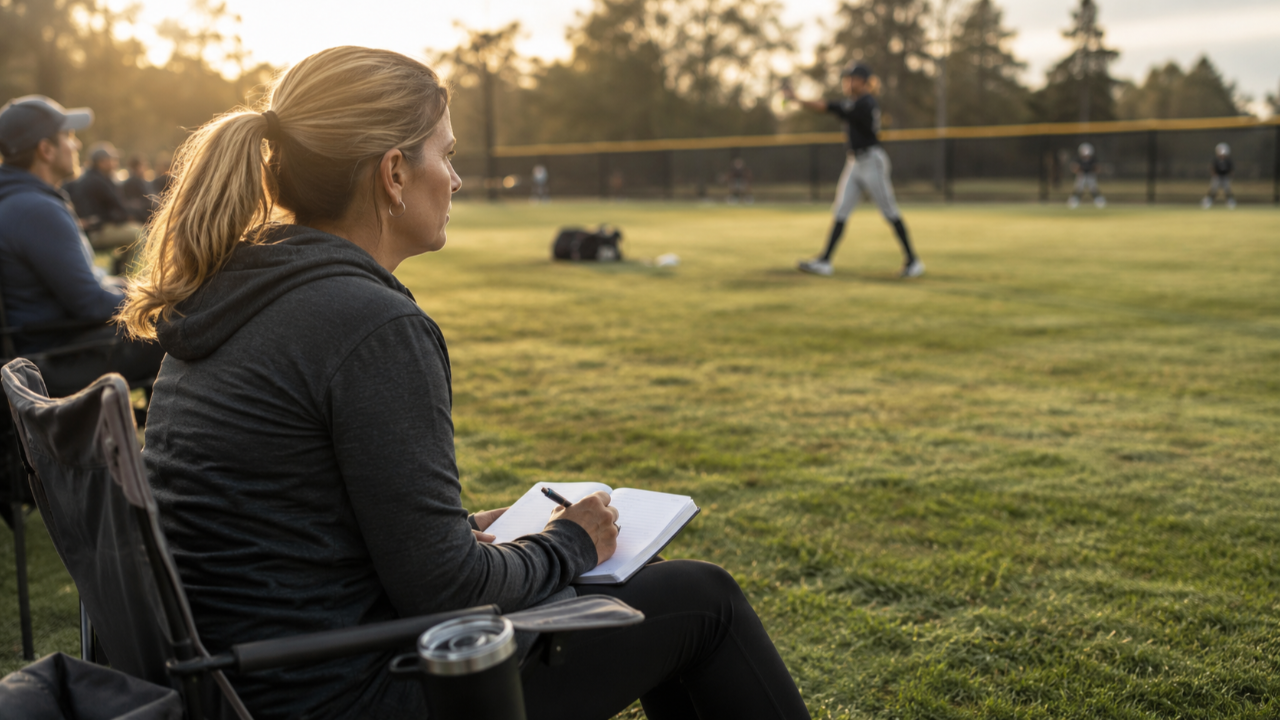
We're following all the rules… so why does it still feel off?
A practical, week-by-week guide for parents who want to read their pitcher's arm clearly — not just react to it.
You've heard "he's fine" enough times to start doubting the phrase. Coach says it. The trainer says it. Your pitcher says it. And yet — something keeps nagging at you. Maybe it's the way he rolled his shoulder after his last bullpen. Maybe it's the two days of stiffness that are starting to feel normal. Maybe it's just a feeling you can't quite name.
"I don't know if I'm being paranoid or if something's actually wrong."
That sentence lives in the back of a lot of parents' heads from February to August. And the honest answer is: that feeling isn't paranoia. It's information. The problem isn't that you're worried — it's that you don't have a reliable way to check what you're seeing against something concrete. So you're left guessing. Every week.
This guide gives you a different approach. Not a checklist. Not a pitch count. A simple, repeatable way to read your pitcher's arm state week to week — and make a clearer decision about what that means for throwing.
We'll organize it around three zones most parents already understand once they see them: Green, Yellow, and Red. By the end, you'll know exactly what questions to ask each week and what each answer actually means.
Why "Sore or Hurt?" Is the Wrong Question to Start With
The sore-versus-hurt question is actually the second question — not the first. The real starting question is: what is the arm doing this week compared to last week?
Here's why the framing matters. Youth baseball arm pain is rarely a single event. It builds. A pitcher who ends a start with tight forearms on Week 2, throws a bullpen through it on Week 3, and competes in back-to-back games on Week 4 isn't unlucky — he's accumulated a pattern. The soreness wasn't the warning. The pattern was. But if you're asking "sore or hurt?" after every game, you're only ever catching the end of the story.
The more useful question: Is what I'm seeing this week part of a pattern, or is it something new?
Normal soreness from youth pitcher arm fatigue is diffuse — it tends to sit in the muscles of the forearm or upper arm, resolves within 24 to 48 hours after activity, and doesn't change how the pitcher moves or carries himself. That's a very different picture from soreness that sits in a specific spot (medial elbow, posterior shoulder), lingers past 72 hours, or shows up in how he walks to the mound.
Pitch counts tell you volume. A cleared-to-throw note tells you medical status. Neither one tells you how the arm is actually handling stress right now. That's the gap this guide is designed to fill. (And it's the same gap the Arm State Read addresses directly.)
What Does a Green Week Look Like for a Youth Pitcher?
A Green week means the arm is handling its workload. The pitcher is recovering between sessions, moving freely, and not compensating in ways that indicate protective guarding.
Specifically, Green looks like this:
- Soreness clears within 24–48 hours after a bullpen or game start — it doesn't carry into the next day of school or practice
- The pitcher warms up at a normal pace — no extended arm shaking, no reluctance to throw at full effort once loose
- Velocity and command are consistent with recent baselines (a 2–5 mph dip on a particularly heavy week is normal; persistent dips are not)
- He's not rubbing, rotating, or guarding the arm between pitches or in the dugout — no Elbow Rub, no Shoulder Shrug patterns
- His mood around throwing is neutral to positive — not dreading it, not looking for outs
Green doesn't mean perfect. It means the arm is responding. A pitcher who runs Green most weeks can handle a fuller workload, back-to-back game weekends, or an added bullpen session mid-week without unusual risk. The decisions in a Green week are about workload management, not warning signs.
For a deeper look at the specific arm fatigue signs to watch — including behavioral ones most parents miss — that page walks through the full pattern list.
When Is Youth Pitcher Arm Soreness a Yellow Signal?
Yellow means something has shifted. The arm isn't in crisis — but it's asking for more attention than it got last week. Yellow is where most parents either overreact (shut everything down) or underreact (push through because "it's not that bad"). Both responses make Yellow harder to manage.
Yellow looks like:
- Soreness that lingers past 48 hours — still present on Day 3 after a game start or heavy bullpen
- Soreness that is more location-specific than usual: medial elbow, posterior shoulder, or a spot the pitcher can point to with one finger (that precision is information)
- A subtle change in warm-up behavior — extra shaking, longer time to feel "ready," or needing more throws to feel loose than usual
- A velocity drop that's consistent across multiple outings rather than just one rough game
- Low-grade Stiff Turn patterns in the morning — rotating the neck or shoulder with more effort than normal the day after throwing
- The "I'm Fine" Mask showing up — your pitcher is telling you he's fine, but his warm-up, his body language between innings, and the way he carries his arm don't match his words
Yellow is not "stop throwing." Yellow is "adjust this week and watch closely." What Yellow asks of you is a lighter workload, a genuine recovery window before the next throwing session, and sharper attention to whether it improves or worsens over 5–7 days.
"I don't want to overreact, but I also don't want to ignore it." That sentence describes Yellow perfectly. The answer in Yellow isn't a dramatic decision — it's a calibrated one. Fewer throws, more recovery, clear eyes on what changes.
For context on what healthy recovery between games should look like during a Yellow week, that guide covers the practical structure.
What Does Red Look Like — and When Should You Stop Guessing?
Red means stop throwing and get a professional evaluation. Not "wait and see." Not "he can throw through it." Stop.
Red signals in youth baseball arm pain include:
- Sharp, acute pain during a throw — mid-pitch or immediately after — that is clearly different from soreness
- Any pain on the medial (inside) elbow that hasn't resolved within 72 hours and worsens with activity rather than improving
- Sudden velocity loss of more than 5–8 mph that persists across multiple outings with no other explanation (illness, mechanics change, fatigue from an unusually heavy stretch)
- Swelling, visible asymmetry between the throwing arm and non-throwing arm, or a sensation the pitcher describes as "popping," "catching," or "giving way"
- The Confidence Spiral showing up — your pitcher starts avoiding throwing situations, skipping warm-ups, or expressing anxiety about pitching in a way that's new and unexplained
- Soreness that spreads or migrates to new locations rather than staying in one place
One clarification that matters: cleared ≠ ready. A pitcher who has been medically cleared after an evaluation is not automatically in Green. Clearance answers the medical question. It doesn't answer the readiness question — which is about how the arm is actually responding to throwing load week to week. Those are two different measurements.
When you're in Red, the question of when to rest a youth pitcher has already been answered. The decision is no longer a parent call — it's a provider call. Your job in Red is to stop second-guessing the decision to stop and get the right eyes on it.
What Three Questions Should Parents Ask Every Week?
Most parents track too much scattered information and not enough consistent information. The fix isn't a longer checklist — it's three questions, asked the same way, every week.
These questions are the core of the VeloRESET Decision Loop: Notice what's changing → Understand what it means → Adjust workload → Support recovery. They don't require a clinic visit or a pitching coach. They require 10 minutes of honest observation.
Question 1: How did the arm recover this week?
Ask this 48 hours after the last throwing session. Is the soreness gone, reduced, or still present? Can your pitcher move through a full range of motion without guarding? Is he moving his arm normally in everyday activity — reaching, carrying a backpack, throwing casually in the yard? Recovery trajectory is more informative than the soreness itself. An arm that is consistently better at 48 hours is Green. An arm that is still present at 72 hours is Yellow until proven otherwise.
Question 2: What did the arm look like during warm-up and between innings?
This is where behavioral signals live — and they're often the earliest indicators of youth pitcher arm fatigue before any pain is reported. Watch the warm-up pace. Watch what he does in the dugout. Watch for the six patterns documented in The 6 Arm Signals Every Baseball Parent Misreads: Elbow Rub, Shoulder Shrug, Stiff Turn, Sudden Velocity Dip, "I'm Fine" Mask, Confidence Spiral. You don't need all six. One consistent pattern, showing up across multiple outings, is worth noting.
Question 3: What's different this week compared to last week?
This is the pattern question. Not "is something wrong?" but "what changed?" A pitcher who goes from Green to Yellow in a single week had something change — a heavier game schedule, a longer bullpen, a cold night, a mechanical adjustment, a stressful stretch at school. Pattern shifts have causes. Your job isn't to diagnose the cause — it's to notice that something shifted and decide whether to adjust workload before the pattern worsens.
Three questions. Same week. Consistent answers over 4–6 weeks tell you more than any single game ever will.
Frequently Asked Questions: Youth Pitcher Arm Soreness and Weekly Decisions
How long should normal arm soreness last in a youth pitcher?
Normal muscle soreness from pitching typically resolves within 24 to 48 hours after a game or bullpen session. If soreness is still clearly present at 72 hours — especially if it's location-specific (inside of the elbow, top of the shoulder) rather than diffuse across the forearm or upper arm — that's worth tracking closely. Soreness that persists past 72 hours consistently, or that is present before the pitcher even throws, is a Yellow signal that warrants a lighter week and closer attention.
Is it safe for a youth pitcher to throw through arm soreness?
It depends on where the soreness is and how it behaves. Diffuse forearm soreness that resolves within 48 hours is generally within the range of normal muscle fatigue. Location-specific soreness — especially on the medial (inside) elbow, which is where youth pitchers are most vulnerable to growth plate stress — is not something to throw through without a clearer picture of what's driving it. Medial elbow tenderness that persists past 72 hours is the primary symptom of Little League elbow, the most common growth plate injury in pitchers ages 10–15. The general principle: soreness that improves with rest and warmup is different from soreness that worsens during throwing. The second category always warrants stopping.
My pitcher says his arm feels fine but his velocity dropped. Should I be concerned?
Yes — pay attention to this pattern. A consistent velocity drop (more than 2–5 mph across multiple outings, not a single rough game) paired with an "I'm fine" report is one of the more reliable early indicators of arm fatigue in youth pitchers. Pitchers — especially competitive ones — are motivated to report fine when they don't feel fine. Their warm-up behavior, between-inning habits, and actual pitch outcomes are often more accurate than their self-report. If the velocity drop is consistent and unexplained, treat it as a Yellow signal regardless of what your pitcher says.
What is the Green / Yellow / Red Readiness Spectrum?
The Green / Yellow / Red Readiness Spectrum is a simple, repeatable way to describe a pitcher's arm state in a given week — replacing the binary "fine vs. hurt" frame that leaves most parents stuck. Green means the arm is recovering and handling its workload well. Yellow means something has shifted and the week calls for adjusted load and closer observation. Red means throwing should stop and a professional evaluation is needed. The spectrum is designed to help parents make week-to-week decisions without requiring medical expertise — by reading observable signals consistently over time rather than reacting to individual moments.
How is youth pitcher arm soreness different from a real injury?
The clearest difference is location, acuity, and trajectory. Normal youth baseball arm soreness is diffuse (spread across a muscle group), mild to moderate in intensity, and improves with rest within 48 hours. Injury-level pain tends to be location-specific (a spot the pitcher can identify precisely), sharp rather than achy, and either doesn't improve with rest or worsens with activity. Any pain that is described as sharp during a throw, that sits on the medial elbow and doesn't improve within 72 hours, or that is accompanied by swelling or asymmetry should be evaluated by a sports medicine provider — not managed at home. When in doubt, the risk of evaluating something that turns out to be fine is far lower than the risk of waiting on something that isn't.
For a single resource that connects all of VeloRESET's parent decision tools in one place, visit the Arm Care Decision Hub.
Not sure if this week is Green, Yellow, or Red?
The VeloRESET Arm State Read asks 9 questions about your pitcher's arm this week and gives you a personalized Green / Yellow / Red read — what's driving it, what to do next, and what to stop worrying about.
Get the Arm State Read — $27One-time · Complete in 5 minutes · 30-day Calm Parent Guarantee